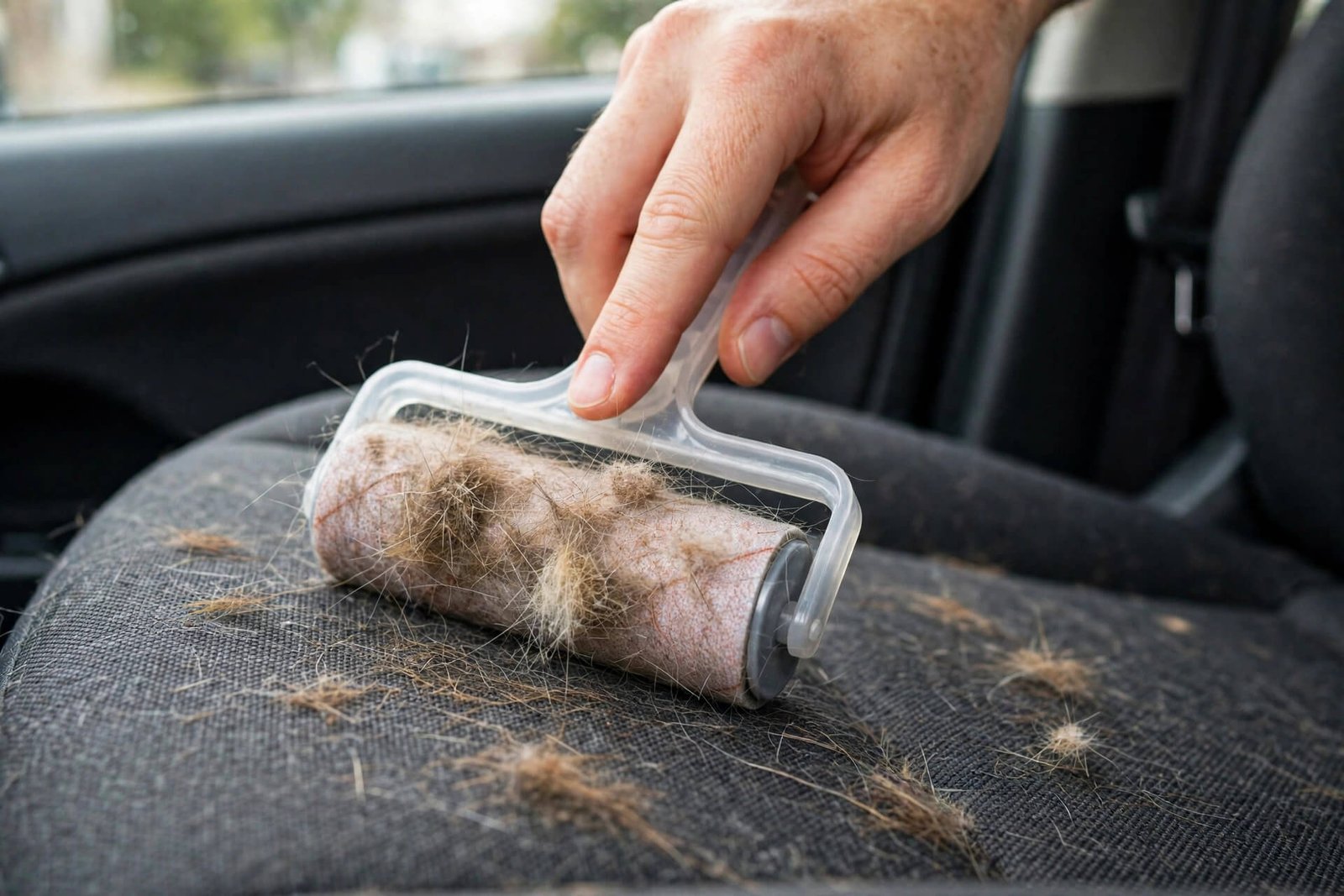
Dog hair weaves itself into car seats and carpet in a way a vacuum alone rarely fixes. The hair works down into the weave, hooks around the fibres, and stays put even after several passes with a crevice tool. The best pet hair removers for car upholstery solve that problem by loosening the hair first, so the vacuum can actually pick it up. A rubber blade, a metal scraper, or a reusable roller drags the embedded hair into loose piles, and then one vacuum pass clears it away.
The right tool depends on the surface. Flat cloth seats respond well to a reusable roller, while short, dense car carpet needs a rubber or metal edge that can dig into the pile. Leather and vinyl are a different case again: they do not trap hair in a weave, so a damp cloth or a soft rubber tool is usually enough, and a sharp metal edge should be kept away from them. Buying one tool for every surface usually means it works well on none of them, so it helps to know what you are cleaning before you choose.
In this guide, we compare five tools that cover the main surfaces in a car: a reusable roller for flat fabric, a small triangle tool for mats and seats, a two-piece rubber kit for corners and crevices, a metal scraper for deeply embedded carpet hair, and a dual-blade scraper for quick clean-ups. We also explain the loosen-then-vacuum method that makes all of them work better, and which surfaces each tool should stay away from.
Best Pet Hair Removers For Car Upholstery at a Glance
Short on time? These five picks cover the main jobs. The best pet hair removers for car upholstery below are all reusable, with no adhesive refills to buy, except where a roller is the right tool for a quick flat-surface pass. Match the tool to the surface first, and keep a vacuum nearby for the final pass.
| Product | Type | Best for | Surfaces to avoid |
|---|---|---|---|
| ChomChom Roller | Reusable roller | Flat fabric seats | Leather and vinyl |
| Analan Mini | Triangle rubber tool | Car mats and seats | Delicate knits |
| Lilly Brush Pro Kit | Two rubber tools | Corners and crevices | Delicate knits |
| Uproot Cleaner Pro | Metal scraper | Deeply embedded carpet hair | Delicate fabrics, leather |
| FURCOBRA Pro | Dual-blade scraper | Quick carpet clean-ups | Delicate fabrics |
Before you buy, look at where the hair actually is. If it sits on top of flat seat fabric, a roller is the fastest fix. If it is woven into the carpet, you need a rubber or metal edge first, and a roller alone will struggle. Check the surface too: a metal scraper that works well on low-pile carpet can snag loose weaves and should never be used on leather.
1. ChomChom Roller — Best Overall for Flat Fabric
The ChomChom Roller is the most widely recommended reusable roller for pet hair, and it earns that place because it is simple. You roll it back and forth over the surface, and its brushes pull hair into a chamber inside the roller. There are no adhesive sheets to replace, no batteries, and nothing to plug in. When the chamber is full, you press a button to open it and empty the hair out.
- Type: Reusable roller with a hair-collection chamber
- Refills: None needed; no adhesive sheets
- Best surfaces: Fabric upholstery, couches, rugs, and car seats
- Limitation: Near-useless on smooth leather and vinyl, where there is no weave for the brushes to grip
Pros: No refills to buy; hair collects in a chamber that empties easily; fast on large flat areas; works on couches and beds as well as car seats.
Cons: Struggles with hair that is deeply woven into dense carpet; less effective on tightly woven, low-pile fabric; needs a vacuum pass for the hair it loosens but does not collect.
2. Analan Mini Pet Hair Remover — Best for Car Mats and Seats
The Analan Mini is a small triangle-shaped tool made for car detailing, and its size is the point. At about 4.7 inches across, it fits in one hand and reaches into the places a full-size roller cannot: the corners of a seat, the edge of a floor mat, and the seam where the seat meets the backrest. Its rubber edges tug embedded hair out of fabric and carpet fibres into clumps for vacuuming. It has three edges with different tooth sizes, so you can turn it to suit the surface, and it rinses clean under water when it is dirty.
- Type: Small triangle hand tool with rubber edges
- Size: About 4.72 by 4.72 by 0.78 inches; weighs about 5.1 ounces
- Best surfaces: Car mats, car seats, couches, and carpet
- Care: Rinse clean under water; no refills needed
Pros: Small enough for tight corners and seams; three edges suit different surfaces; rinses clean; light and easy to keep in the car.
Cons: Slow on a large area such as a whole cargo carpet; needs a vacuum to finish the job; the small size means more passes on a wide rear bench.
3. Lilly Brush Pro Pet Hair Tool Kit — Best Kit for Corners and Crevices
The Lilly Brush Pro Kit is a two-piece rubber tool set, and it is the most car-specific kit in this guide. It includes a wide detailer, about 10.5 inches long, and a slim crevice tool, about 14 inches long, for the gap between seats and against plastic trim. The rubber blades grip hair and pull it into neat piles with short, rake-like strokes, held at a slight tilt. The crevice tool is the part other tools in this guide do not offer: it reaches the narrow gap where a vacuum nozzle and a roller both fail.
- Type: Two rubber-bladed tools, no handle or power needed
- Sizes: Wide detailer about 10.5 inches; crevice tool about 14 inches
- Best surfaces: Car carpet, car seats, couches, and auto interiors
- Method: Short, rake-like strokes, then vacuum up the gathered hair
Pros: Two tools cover wide areas and tight gaps; rubber blades are gentle on fabric; the crevice tool reaches between seats; no refills or power needed.
Cons: Needs more physical effort than a roller on a large area; rubber blades need cleaning between passes; not the fastest choice for a quick flat-seat touch-up.
4. Uproot Cleaner Pro — Best for Deeply Embedded Carpet Hair
The Uproot Cleaner Pro is a metal scraper, and it is the strongest tool in this guide for hair that seems fused to the carpet. It uses a textured metal edge with fine ridges to drag embedded undercoat fur out of low-pile carpet, rugs, and dense upholstery. The two-pack version includes two identical tools, so you can keep one in the car and one in the house. It is reusable, washable, and needs no batteries or adhesive sheets. The maker warns against using it on knitted and delicate fabrics, and that warning should be taken seriously: the same edge that pulls hair out of carpet can snag loose threads.
- Type: Metal scraper with a textured, ridged edge
- Size: About 4.2 by 3.25 inches per tool; two-pack
- Best surfaces: Low-pile carpet, rugs, stair runners, and dense upholstery
- Do not use on: Knitted and delicate fabrics, loose weaves, and leather
Pros: Strongest pull on deeply embedded carpet hair; reusable and washable; no refills; the two-pack covers car and home.
Cons: Can snag delicate or loose fabrics; needs a careful, even pressure; not suitable for leather or vinyl; slower than a roller on flat, loose hair.
5. FURCOBRA Pro Pet Hair Remover — Best Dual-Blade Scraper
The FURCOBRA Pro is a compact dual-blade scraper, about 4.3 inches wide, made for quick clean-ups on car interiors, carpets, and furniture. Its two blades work from different angles, so a few short scrapes gather hair into a pile that can be picked up or vacuumed away. It is reusable, with no sheets to replace, and its small size makes it easy to keep in a glove box or a door pocket. It is a fast, everyday tool for hair that builds up between deeper cleans.
- Type: Reusable dual-blade scraper, about 4.3 inches wide
- Best surfaces: Car interiors, carpets, couches, beds, and furniture
- Care: Rinse or wipe clean; no refills needed
- Size: Compact and light enough to keep in the car
Pros: Fast for quick clean-ups; compact enough to store in the car; dual blades gather hair from more than one angle; no refills to buy.
Cons: Less effective than a metal scraper on deeply embedded carpet hair; needs a vacuum to finish; not for delicate fabrics or leather.
How to Choose the best pet hair removers for car upholstery
Choosing among the best pet hair removers for car upholstery starts with the surface, not the brand. Hair behaves differently on flat cloth, dense carpet, and smooth leather, and the tool that works on one can be useless or even harmful on another. Work through the points below with your own car in mind, and you will end up with one or two tools that actually get used, instead of a drawer full of gadgets.
Match the tool to the surface
On flat fabric seats, a reusable roller such as the ChomChom is the fastest option, because the hair sits on the surface and the brushes can collect it. On short, dense car carpet, a rubber tool such as the Analan or the Lilly Brush kit is better, because the rubber edge drags hair out of the weave. On low-pile carpet where hair is deeply embedded, a metal scraper such as the Uproot Cleaner Pro pulls out hair that rubber leaves behind. On smooth leather or vinyl, skip the scrapers entirely: a damp cloth or a soft rubber tool is enough, because there is no weave to trap the hair.
Use the loosen-then-vacuum method
The method matters more than the tool. The best pet hair removers for car upholstery work best in a short sequence: loosen the hair first with a rubber or metal tool, gather it into piles, then vacuum it away. Suction alone only pulls at the loose top layer, because embedded hair has to be agitated first. Work in one direction with short strokes, gather the hair into a pile, and finish with the vacuum crevice tool. A roller alone struggles on car carpet for the same reason: it can collect loose hair, but it cannot dig the woven hair out first.
Check the size against your car
A full-size roller is fast on a wide rear bench but awkward in the footwell and around the seat rails. A small triangle tool is slow on a cargo carpet but perfect for the seam beside the seat. If you clean the whole car at once, a kit with two sizes, such as the Lilly Brush Pro, covers both jobs. If you only need quick touch-ups between washes, a compact scraper that lives in the glove box is more likely to be used than a large tool kept in the garage.
Avoid the tools that damage fabric
Metal and pumice tools can pull loose carpet fibres and leave a fine powder, so test them first on a hidden spot and keep them off cloth seats, headliners, and leather. Rubber tools are the safest choice for most interior materials, though they need more effort on heavy shedding. Whatever you choose, do not use a scraper on a knitted seat cover or a loose weave, and do not press harder to make up for a dull edge: short, even strokes work better and are kinder to the fabric. For the bigger picture, our guide to car seat covers for dogs explains how a seat cover reduces the hair that reaches the upholstery in the first place, and our car travel accessories checklist covers the other gear worth keeping in the car.
How to Remove Pet Hair from Car Upholstery, Step by Step
Start with a dry pass. Take everything out of the footwells and off the seats, then use a rubber or metal tool with short strokes in one direction to loosen the hair and gather it into piles. Then vacuum the whole area with a brush or crevice tool.
- Work in one direction with short strokes, so the hair gathers instead of spreading.
- Gather the loosened hair into piles before you vacuum, or the vacuum will miss it.
- Use the crevice tool for the gap between the seat and the console.
- Finish with a quick roller pass on flat seat faces for stragglers.
If the hair is still stuck after two passes, dampen the area very lightly or use a damp rubber glove: moisture helps the hair clump, but too much water can soak into the seat. The best pet hair removers for car upholstery in this guide are all manual, so there is no battery to charge and no cord to manage, but they do need a vacuum for the final pass. For dogs that ride often, a washable cover helps too: see our roundup of waterproof car seat protectors for pets for covers that keep hair and mud off the seat itself.
Common Mistakes to Avoid
The most common mistake when shopping for the best pet hair removers for car upholstery is buying a roller and expecting it to clean car carpet. A roller is a good tool, but it is a finishing tool: on dense carpet it collects the loose hair and leaves the woven hair behind, so the carpet still looks furry after you have finished. The second mistake is vacuuming first and loosening second, which is backwards: suction cannot pull out hair that is hooked into the weave, so the loosening step has to come first. The third mistake is using a metal or pumice tool on the wrong surface, which can pull fibres out of a carpet or snag a seat cover. The fourth mistake is cleaning in every direction at once, which spreads the hair instead of gathering it. Work in one direction, gather the piles, and then vacuum, and the same tools will do a much better job.
Frequently Asked Questions (FAQ)
What is the best pet hair remover for car seats?
A rubber-bristle or rubber-blade tool gets the strongest marks for fabric seats, because it loosens embedded hair before the vacuum. The best pet hair removers for car upholstery in this guide include the Analan Mini and the Lilly Brush Pro kit for that job, while the ChomChom Roller is best for quick touch-ups on flat fabric. A damp rubber glove is a solid budget option for gathering hair into clumps.
Why does my vacuum not remove pet hair from car carpet?
Suction only pulls on the loose top layer. Embedded hair is hooked into the carpet weave, so it has to be agitated first with a rubber or metal tool. Loosen the hair into piles with short strokes, then vacuum the piles away. Without the loosening step, even a strong vacuum will leave most of the hair behind.
Can I use a pet hair remover on leather car seats?
Yes, but with care. Silicone and soft rubber tools are safe for most leather finishes, and a damp cloth is often enough because leather does not trap hair in a weave. Avoid sharp metal edges and abrasive pumice tools on leather and vinyl, and test any new tool on a small, hidden area first.
Is the ChomChom Roller good for car upholstery?
Yes, for flat fabric upholstery. It is reusable, needs no adhesive sheets, and collects hair in a chamber that empties easily. It works less well on dense car carpet, where the hair is woven in, and it is near-useless on smooth leather or vinyl, where the brushes have nothing to grip.
How do I clean pet hair from the gap between car seats?
Use a slim crevice tool, such as the 14-inch tool in the Lilly Brush Pro kit, or the edge of a small triangle tool. Slide it into the gap with short strokes to pull the hair out, then use the vacuum crevice tool to pick it up. A full-size roller is too wide for this gap, so a slim tool is the right choice.
Do I need more than one pet hair remover for my car?
Most owners with a shedding dog do. One tool rarely covers flat seats, dense carpet, and tight gaps equally well. A common pairing is a rubber tool for the carpet, a roller for flat seats, and a slim tool for the gaps, with a vacuum for the final pass on every surface.
How often should I remove pet hair from my car?
A quick pass after each trip with a dog keeps the hair from working deep into the weave, and a deeper clean once a week is enough for most owners.
Final Verdict
For most owners, the best pet hair removers for car upholstery to start with are a rubber tool and a roller together. The ChomChom Roller handles flat fabric seats fast, the Analan Mini reaches mats and corners, and the Lilly Brush Pro kit adds the crevice tool that no other pick offers. If your carpet is the worst part of the car, add the Uproot Cleaner Pro for deeply embedded hair, and keep the FURCOBRA Pro in the glove box for quick clean-ups. Loosen first, gather the piles, then vacuum, and the hair will come out instead of staying woven into the seats.
As an Amazon Associate, Car Accessories Reviews earns from qualifying purchases made through affiliate links on this page, at no extra cost to you. Prices and availability can change, so please check the Amazon listing for the latest details before you buy.