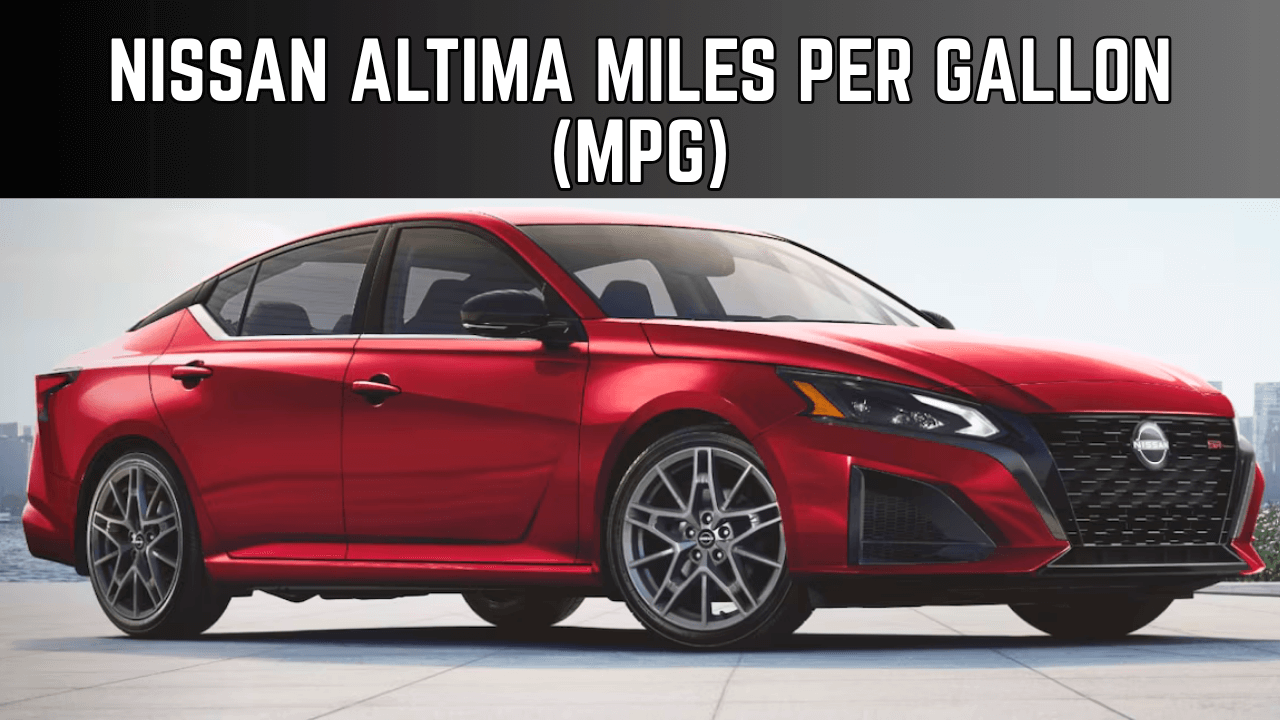
Introduction to the Nissan Altima
A Legacy of Efficiency and Comfort
The Nissan Altima is one of the most recognized midsize sedans in the United States, blending comfort, performance, and above all, fuel efficiency. Since its introduction in 1992, the Altima has become a go-to vehicle for drivers seeking a dependable ride without breaking the bank at the pump. Whether you’re commuting through city traffic or cruising on the highway, the Altima is designed with fuel economy in mind. Over the years, Nissan has made consistent improvements to the Altima’s engine technology and aerodynamics, which translates directly into improved MPG ratings.
Its reputation is built not just on its performance, but also on reliability and economy. Many families choose the Altima for its ability to go the distance—literally. Its stylish design hides a practical heart: efficient engine options, lightweight materials, and continuous variable transmission (CVT) that together contribute to better fuel performance.
Another bonus? The Altima doesn’t ask drivers to sacrifice comfort or features to gain efficiency. Even base trims offer a well-equipped cabin, tech-friendly systems, and a smooth ride. For environmentally conscious or budget-savvy buyers, the Altima continues to be a top contender in the midsize sedan category.
Why MPG Matters in Today’s Market
MPG—or miles per gallon—is no longer just a nerdy car spec for gearheads. It’s a make-or-break feature for many car buyers, especially with the rising and unpredictable cost of fuel. A higher MPG means fewer trips to the gas station, lower fuel expenses, and a lighter carbon footprint. It’s the trifecta of benefits.
In today’s economy, where inflation touches every corner of a family’s budget, fuel efficiency becomes crucial. Every mile you squeeze out of a gallon of gas can save you significant money over the lifespan of your vehicle. And for those who are eco-conscious, a better MPG rating also means fewer emissions, contributing to a cleaner planet.
The Nissan Altima, with its lineup of efficient engines and aerodynamic build, continues to appeal to this growing group of buyers. It’s not just about getting from point A to B anymore—it’s about how efficiently, affordably, and responsibly you can do it.
Nissan Altima MPG Calculator
Estimate the miles per gallon (MPG) of your Nissan Altima by entering miles driven and gallons used.
Understanding MPG – What Does It Really Mean?
City vs. Highway MPG
When browsing car specs, you’ll see two MPG numbers: city and highway. But what’s the difference? Simply put, city MPG measures how far your car can go on a gallon of gas during stop-and-go driving—think traffic lights, stop signs, and bumper-to-bumper situations. Highway MPG, on the other hand, measures how far you can drive on one gallon of fuel during steady-speed travel, like cruising down the interstate.
The Nissan Altima tends to score higher on highway MPG thanks to its aerodynamic profile and efficient CVT. For example, recent models boast up to 39 MPG on the highway and around 27–28 MPG in the city, depending on the trim and engine configuration.
Why the difference? In city driving, cars use more fuel during acceleration, idling, and braking. Meanwhile, highway travel allows the Altima’s engine to operate more efficiently at a consistent speed with fewer interruptions.
Understanding this distinction helps buyers choose the right vehicle based on their driving habits. If you’re a daily city commuter, focus more on city MPG. If you hit the open road regularly, highway MPG becomes the hero.
How MPG is Measured
Ever wonder how those MPG numbers are calculated? In the U.S., the Environmental Protection Agency (EPA) is responsible for testing and rating fuel economy. These tests simulate real-world driving using controlled lab conditions. Cars are put through standardized cycles mimicking urban and highway conditions.
The test includes accelerations, decelerations, idle time, and cruising to represent average daily usage. While helpful, it’s important to remember these numbers are estimates. Real-world factors like traffic, terrain, climate, and driving style can cause actual MPG to vary.
That said, the EPA’s ratings still provide a reliable benchmark for comparing different vehicles. The Nissan Altima consistently performs well in these tests, proving itself as one of the more efficient sedans on the market.
Nissan Altima MPG Ratings by Year
2024 Nissan Altima MPG

Credit: bignissannortholmsted.com
The 2024 Nissan Altima continues to deliver solid fuel economy, making it a favorite for budget-conscious and eco-conscious buyers alike. This model comes equipped with two engine choices: a 2.5-liter four-cylinder and a 2.0-liter turbocharged four-cylinder, paired with a continuously variable transmission (CVT).
- 2.5-liter engine (FWD): 27 MPG city / 39 MPG highway / 32 MPG combined
- 2.5-liter engine (AWD): 26 MPG city / 36 MPG highway / 30 MPG combined
- 2.0-liter turbocharged engine (FWD only): 25 MPG city / 34 MPG highway / 29 MPG combined
What’s striking is that even the turbocharged variant, known for its added power, maintains respectable MPG numbers. This makes the Altima a versatile choice for drivers who want a balance between performance and efficiency.
MPG Trends Over the Last Decade
Over the past 10 years, Nissan has steadily enhanced the Altima’s fuel efficiency. Thanks to lighter materials, advanced engine tuning, and improved aerodynamics, newer Altimas outpace their predecessors in MPG ratings.
For instance:
- 2013 Altima (2.5L FWD): 27 city / 38 highway
- 2016 Altima (2.5L FWD): 27 city / 39 highway
- 2019 Altima (2.5L AWD): 26 city / 36 highway
- 2021 Altima (2.5L FWD): 28 city / 39 highway
While the numbers haven’t drastically shifted year-to-year, the cumulative improvement is clear. Nissan has prioritized small tweaks each model year, and the result is a well-optimized fuel-efficient machine.
Comparing Different Trims and Engine Options
Not all Altimas are created equal. Trim level and engine choice can influence MPG quite a bit. The base trims (S and SV) with the standard 2.5L engine deliver the best fuel economy. Meanwhile, higher trims like the SR or Platinum, which may include AWD or turbo engines, typically trade a few MPG points for added features or performance.
If maximum MPG is your goal, stick with:
- 2.5L engine
- Front-Wheel Drive (FWD)
- Lower to mid-range trims (like SV or SL)

Govee Car LED Lights, Smart Car Interior Lights with App Control, RGB Lights with DIY Mode and Music Mode, 2 Lines Design LED Lights for Cars with Car Charger, 12V
Factors That Affect the Nissan Altima’s MPG
Driving Habits and Style
Believe it or not, how you drive plays a massive role in your Nissan Altima’s MPG. Aggressive driving—think hard acceleration, rapid braking, and speeding—can cut your fuel economy by up to 30% on the highway and around 10% in the city. If you’re wondering why your MPG isn’t matching the sticker estimate, your driving style could be the culprit.
Smooth, steady driving helps the Altima’s engine run efficiently. When you accelerate gently, coast to stops, and maintain a consistent speed, your vehicle doesn’t have to work as hard—meaning less fuel is used. Cruise control on the highway can be a huge help here, keeping your speed constant and fuel use optimized.
Short trips are another MPG killer. If you’re only driving a few miles, the engine doesn’t get a chance to reach optimal temperature, and cold engines burn more gas. So if your commute is just down the block, don’t be surprised if your MPG looks worse than advertised.
Vehicle Maintenance and Condition
Keeping your Altima in top shape isn’t just about performance—it’s essential for fuel efficiency too. Let’s start with the basics: tire pressure. Underinflated tires create more rolling resistance, which forces the engine to work harder and burn more fuel. Check your tire pressure monthly to keep things running smoothly.
Next up: oil changes. Using the recommended grade of motor oil and changing it at proper intervals ensures your engine runs as efficiently as possible. Dirty oil increases friction, which lowers MPG.
Also, consider the air filter and spark plugs. A clogged air filter restricts airflow to the engine, reducing performance and efficiency. Faulty spark plugs can cause misfires, which waste fuel and increase emissions.
Even the alignment of your wheels matters. Misaligned wheels create drag, which again lowers MPG. Keeping your Altima well-maintained might seem like a chore, but it’s your best bet for preserving its fuel-saving capabilities.
Motor Trend FlexTough Floor Mats for Cars, Black Deep Dish All-Weather Mats, Waterproof Trim-To Fit Automotive Floor Mats for Cars Trucks SUV, Universal Floor Liner Car Accessories
Environmental and Road Conditions
Sometimes, it’s not about the car or the driver—it’s the environment. Cold weather lowers MPG significantly because engines take longer to reach an efficient operating temperature. Plus, winter-grade fuels have less energy content, and using heaters, defrosters, and heated seats only adds to fuel use.
Hilly terrain and stop-and-go traffic are other MPG killers. Uphill drives require more throttle, burning more gas. Likewise, city traffic with constant stops means the engine repeatedly accelerates, which guzzles fuel faster than a smooth, uninterrupted drive.
Even wind and rain can subtly impact MPG. Strong headwinds make your engine work harder, while heavy rain increases rolling resistance between your tires and the road.
Gas Mileage Comparison with Other Midsize Sedans
Nissan Altima vs. Honda Accord
The Honda Accord is often seen as the Altima’s archrival. Both sedans compete in the same segment and offer similar features, but what about fuel efficiency?
- Honda Accord 2024 (1.5L Turbo): 29 MPG city / 37 MPG highway / 32 combined
- Nissan Altima 2024 (2.5L FWD): 27 MPG city / 39 MPG highway / 32 combined
As you can see, the numbers are incredibly close. The Accord pulls ahead slightly in city driving, but the Altima wins on the highway. In real-world driving, the difference may be marginal, but if you’re a highway commuter, the Altima may be a more efficient option.
Nissan Altima vs. Toyota Camry
Toyota is famous for reliability and efficiency, and the Camry doesn’t disappoint:
- Toyota Camry 2024 (2.5L FWD): 28 MPG city / 39 MPG highway / 32–34 combined
- Nissan Altima 2024 (2.5L FWD): 27 MPG city / 39 MPG highway / 32 combined
The Camry slightly edges out the Altima in city driving and overall combined mileage in some trims, especially the LE hybrid, which hits over 50 MPG combined. But when comparing non-hybrid models, they are virtually tied on fuel economy.
Nissan Altima vs. Hyundai Sonata
The Hyundai Sonata is another strong competitor with good looks and efficiency:
- Hyundai Sonata 2024 (2.5L FWD): 28 MPG city / 38 MPG highway / 32–33 combined
- Nissan Altima 2024 (2.5L FWD): 27 MPG city / 39 MPG highway / 32 combined
Once again, we’re looking at a tight race. The Sonata might edge ahead slightly in combined MPG in certain trims, but Altima offers better highway mileage in most cases. In short, all these midsize sedans are strong on fuel efficiency, and the Altima holds its own very well.
Real-World Owner Experiences and MPG
What Drivers Say About Their Fuel Economy
Specs are helpful, but what really matters is how a car performs in the real world. Altima owners across the country often report achieving—or even surpassing—the advertised MPG, especially during highway driving.
Many drivers note hitting 40+ MPG on long trips with steady speeds. City drivers typically see around 25–28 MPG, depending on traffic and how aggressively they drive. Those who stay on top of maintenance often see consistent results, sometimes even better than EPA estimates.
Online forums, Reddit threads, and Facebook groups are filled with Altima owners sharing fuel-saving tips and stories about their road trips. Many drivers praise the CVT for its smooth operation and fuel-friendly gear transitions.
City Drivers vs. Highway Commuters
Where you drive matters. Urban commuters tend to struggle more with fuel efficiency because of frequent stops, traffic congestion, and short trip lengths. However, highway commuters love the Altima’s gas mileage. On longer drives, with cruise control engaged, it’s not uncommon for drivers to average over 38–40 MPG consistently.
This divide is important if you’re evaluating whether the Altima fits your needs. If most of your time is spent navigating city streets, expect to see a dip from the advertised numbers. But if you’re a road warrior logging hundreds of highway miles each week, the Altima is one of the best non-hybrid options for fuel-conscious drivers.
Tips to Improve Your Nissan Altima’s MPG
Smart Driving Techniques
Want to squeeze every last mile out of your gas tank? It starts behind the wheel. Driving smarter can significantly boost your MPG:
- Avoid jackrabbit starts. Gentle acceleration saves gas.
- Coast to stops. Let your car slow naturally instead of slamming the brakes.
- Use cruise control. It helps maintain consistent speed on highways.
- Lighten your load. Extra weight (like carrying unneeded gear) burns more fuel.
- Plan your trips. Combining errands minimizes cold starts and saves fuel.
You can also monitor fuel economy with the Altima’s onboard trip computer, which shows real-time and average MPG stats. This can help you adjust your driving in the moment.
Maintenance Hacks to Boost Efficiency
Beyond driving habits, there are easy maintenance routines to keep your Altima running efficiently:
- Check tire pressure weekly – Aim for the recommended PSI in your owner’s manual.
- Replace air filters regularly – Dirty filters choke the engine and hurt MPG.
- Use synthetic oil – It reduces engine friction and enhances performance.
- Get regular tune-ups – Ensure spark plugs and fuel injectors are working efficiently.
- Limit use of AC and electronics – These put added strain on the engine.
With the right combination of smart driving and simple maintenance, you can improve your fuel economy by up to 20% or more. That’s not just good for your wallet—it’s great for the environment, too.
Altima’s MPG in Cold vs. Warm Climates
Seasonal Changes in Fuel Economy
You might not realize it, but the weather plays a big role in your car’s MPG. For Nissan Altima owners, especially those living in regions with extreme seasonal temperatures, it’s important to know that fuel economy can dip quite a bit in cold climates.
Why? When temperatures drop, your engine takes longer to reach its optimal operating temperature, meaning it burns more fuel during those first few minutes of driving. Winter gasoline blends used in colder months also contain more additives, which reduce energy content per gallon. Add to that the use of seat warmers, window defrosters, and heaters, and your fuel usage increases without you even noticing.
You may see as much as a 10% to 20% drop in MPG during the winter months compared to the summer. That means if your Altima averages 32 MPG in the summer, it might dip to around 26–28 MPG in colder months—especially if most of your trips are short.
Tips for Maintaining MPG Year-Round
Fortunately, there are several things you can do to minimize seasonal MPG drops:
- Limit idling. Don’t warm up your car for more than a minute—modern engines are built to be driven soon after starting.
- Use seat warmers instead of cabin heaters when possible—they use less fuel.
- Keep your tires properly inflated. Cold air lowers tire pressure, which can hurt fuel efficiency.
- Drive smoothly. Avoid sudden stops and quick acceleration.
- Consider synthetic oil. It flows better in cold temperatures and improves engine efficiency.
During warmer months, you may actually see better than average fuel economy, especially on long highway drives. Keeping your air conditioning use moderate and windows closed at high speeds will help maintain that summer MPG peak.
In short, temperature extremes affect every car’s fuel economy, but with a few adjustments, you can keep your Nissan Altima running efficiently all year long.
The Role of Transmission in MPG
CVT and Its Impact on Fuel Efficiency
One of the reasons the Nissan Altima is known for excellent MPG is its Continuously Variable Transmission (CVT). Unlike traditional automatic transmissions that shift through a fixed set of gears, a CVT continuously adjusts to keep the engine in its most efficient power band.
This flexibility allows the Altima’s engine to operate at lower RPMs during cruising, which saves fuel. It also provides a smoother driving experience with less noticeable gear changes. The CVT is especially effective during highway driving, where its efficiency shines.
Some drivers initially find CVTs a bit odd—there’s no “gear kick” feeling—but over time, most appreciate the seamless performance and improved fuel economy. The CVT in the Altima is one of the best-tuned in the industry, consistently helping the vehicle hit MPG targets and compete with hybrids and small crossovers on efficiency.
Manual vs. Automatic – Which is Better?
While manual transmissions used to be the go-to for drivers seeking better MPG, that’s not the case anymore. Today’s CVTs and advanced automatics often outperform manuals when it comes to fuel economy.
In fact, the Altima hasn’t offered a manual transmission option for years, focusing instead on refining its CVT system. This decision reflects broader industry trends: automatic and CVT technology has advanced to the point where fuel savings, convenience, and performance are all better with an automatic setup.
For Altima drivers, this means you’re getting peak fuel efficiency with minimal effort, letting the transmission do the work while you enjoy the ride.
Future of Fuel Economy in Nissan Sedans
What to Expect from Upcoming Altima Models
Nissan has been dropping hints about big upgrades coming to its sedan lineup—and that includes the Altima. While exact details remain under wraps, the push for improved fuel economy and reduced emissions is clear.
Expect future Altima models to offer:
- Mild-hybrid or full-hybrid powertrains
- Smaller turbocharged engines with better efficiency
- Improved aerodynamics and lightweight materials
- Smarter CVT tuning for maximum fuel savings
As regulatory requirements tighten and consumers demand greener vehicles, Nissan is poised to deliver. Their investment in EV platforms and hybrid technologies suggests that even their gas-powered models will benefit from innovation focused on fuel economy.
Nissan’s Vision for Sustainability
Nissan’s “Ambition 2030” plan outlines a bold future: 50% of global sales will be electric or electrified by the end of the decade. That means hybrid versions of popular models like the Altima are likely on the horizon.
Until then, the current Altima remains one of the most fuel-efficient options in the non-hybrid midsize sedan segment—offering a glimpse into what Nissan does best: blending innovation, value, and performance in one smart package.
Conclusion
When it comes to miles per gallon, the Nissan Altima punches well above its weight. It offers an impressive blend of real-world efficiency, smart engineering, and driver-friendly performance. Whether you’re looking at the 2024 model or shopping for a used gem from the past decade, the Altima consistently delivers strong MPG numbers that compete with—and often exceed—its rivals.
Fuel economy isn’t just a number; it’s peace of mind. It’s knowing you’ll spend less time and money at the pump, all while reducing your environmental footprint. With the Altima, you’re not only getting a reliable and comfortable ride—you’re investing in a vehicle that values efficiency as much as you do.
So, whether you’re a daily commuter, a long-distance road tripper, or someone who just wants a smart, economical sedan, the Nissan Altima is a top choice in the MPG game. It’s efficient, practical, and built to go the distance.
FAQs
What is the average MPG of a Nissan Altima?
The average MPG for a modern Nissan Altima with a 2.5L engine and FWD is 32 MPG combined, with up to 39 MPG on the highway and 27–28 MPG in the city.
How can I increase my Altima’s fuel economy?
Use smart driving techniques like smooth acceleration, maintain proper tire pressure, limit idling, and stay on top of maintenance tasks like oil and filter changes.
Is the Nissan Altima good for long-distance driving?
Absolutely. The Altima’s comfortable ride, spacious interior, and excellent highway MPG make it an ideal choice for long road trips and daily highway commutes.
Does premium fuel improve MPG in an Altima?
Not significantly. The Altima is designed to run efficiently on regular unleaded gasoline. Using premium won’t hurt, but it usually doesn’t result in better MPG unless you’re driving the turbocharged model under performance conditions.
What Altima trim gets the best gas mileage?
The base trims with the 2.5L engine and front-wheel drive (like the S or SV) offer the best MPG, reaching up to 39 MPG on the highway.