Introduction
This ROVE R2-4K dual dash cam review is built around one question that matters more than any spec on the box: is it a good dash cam for the money, or just a good-looking listing?
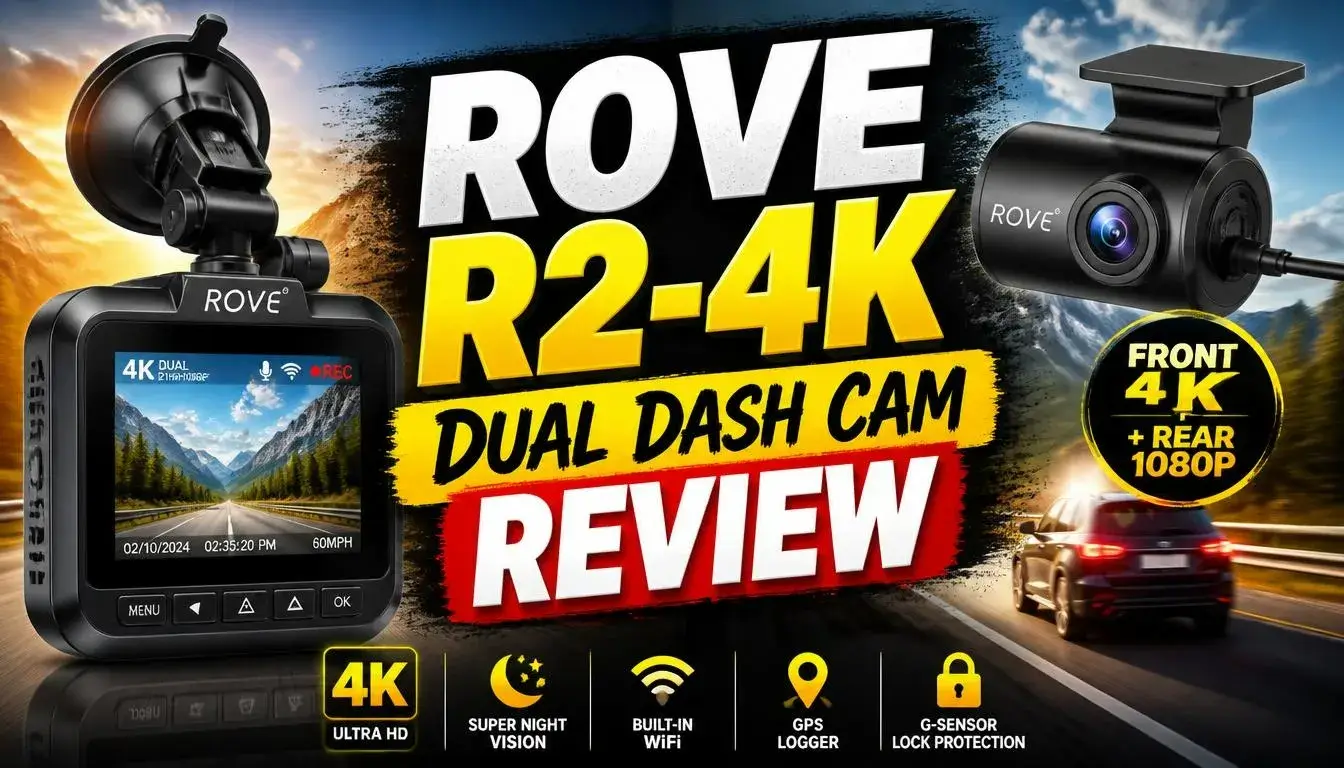
The ROVE R2-4K Dual is one of the most visible dash cams on Amazon. It promises 4K recording at the front, a 1080p camera at the rear, a Sony STARVIS 2 sensor for night video, GPS, fast Wi-Fi, a supercapacitor, a 3-inch screen, and a 128GB memory card in the box, usually at a price well below premium rivals. It is also frequently discounted.
That combination makes it easy to like. It also makes it worth examining closely, because the most detailed independent test we found raises serious questions about the “4K” in the name. The tester behind that review runs a respected dash cam testing channel and has compared the R2-4K Dual against VIOFO’s A229 series, so the findings are specific rather than vague.
Table of Contents
Below we go through the real specs, the video quality, the rear camera, parking mode, the app, installation, and the pros and cons. We also compare it with alternatives, so you can decide whether it deserves a place on your windshield.
Quick Verdict
The ROVE R2-4K Dual is a decent budget dual dash cam with easy features, a bundled memory card, and good value when it is on sale. But it is not a true 4K camera, the rear camera is weak, and parking mode has quirks. It is best treated as a good 2.5K dash cam, not a 4K one.
| Best for | Budget buyers who want front and rear coverage and an easy setup |
| Front camera | 5MP Sony STARVIS 2 IMX675 sensor (marketed as 4K, which independent testing says is a 2.5K sensor) |
| Rear camera | 1080p, Galaxycore GC2053 sensor |
| Key extras | Built-in GPS, Wi-Fi app, OTA updates, supercapacitor, 128GB card included |
| Our take | Good value on sale, but be realistic about the “4K” and the rear camera |
| Where to buy | Check the current price on Amazon |
ROVE R2-4K Dual Specifications
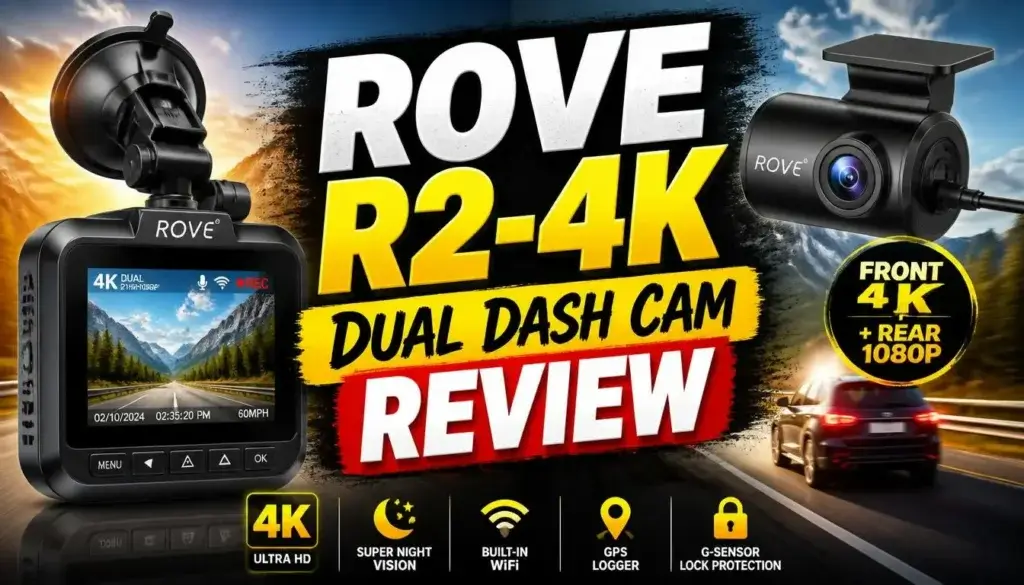
Image Credit: AO Generated
Specifications below come from an independent review by Vortex Radar, who tested the camera after ROVE supplied units, and from retailer listings. Always confirm the exact details on the Amazon page for the version you buy.
| Feature | Details |
|---|---|
| Front sensor | 5MP Sony STARVIS 2 IMX675 |
| Front resolution | Advertised as 4K, tested as 2.5K in reality |
| Front lens | f/1.5 aperture, 150-degree view |
| Front HDR | Yes |
| Rear sensor | 2MP Galaxycore GC2053 |
| Rear resolution | 1080p, f/1.8 aperture, 140-degree view |
| Display | 3-inch IPS screen with physical buttons |
| GPS | Built into the dash cam |
| Wi-Fi | 2.4GHz and 5GHz, advertised up to 20MB/s downloads |
| Video codecs | H.264 and H.265 |
| Power backup | Supercapacitor |
| Parking modes | 1fps time-lapse, motion detection, and collision detection (hardwire cable sold separately) |
| Updates | Over-the-air firmware updates through the iOS or Android app |
| Memory card | 128GB included, supports up to 512GB |
| Mounts | Suction cup and double-stick tape (front), double-stick tape (rear) |
| Optional extras | Hardwire cable and polarizing filter |

- CRYSTAL-CLEAR 4K + 2K DUAL DASH CAM – The ROVE R2-4K DUAL PRO dash cam features 3840x2160P 4K front @30fps and 2560×1440…
- DUAL STARVIS 2 SENSORS IMX678 + IMX675 – Equipped with Sony’s two most advanced STARVIS 2 CMOS sensors— IMX678 (8MP) for…
- LIGHTNING-FAST DUAL BAND WIFI 6 / 30MB/s TRANSFER SPEED – Comes with advanced dual-band WiFi 6 with 5GHz and 2.4GHz, the…
What Comes in the Box
ROVE gets credit for a complete kit. The box includes the front and rear dash cams, both mount types for the front camera, a cigarette lighter power cable, installation tools and cable clips, and a 128GB microSD card.
The included memory card is a real money-saver, since many competitors sell the card separately and a 4K-class card can add a meaningful amount to the total cost. Having both a suction cup and an adhesive mount is also helpful, because you can try the camera in position first, then commit to adhesive.
The hardwire cable needed for full parking mode is not included. You will need to buy it separately, which is something to factor into your budget.
Is the ROVE R2-4K Dual Really 4K?
This is the most important section of any ROVE R2-4K dual dash cam review, so we will be direct.
According to Vortex Radar’s testing, the front camera uses a 5MP Sony STARVIS 2 IMX675 sensor. That is a 2.5K sensor, which is physically incapable of capturing true 4K detail. When you select 4K, the camera records at a lower resolution and then stretches (upscales) the image to fit a 4K file. The result is a file that is labeled 4K but does not contain the detail of a real 4K sensor.
The tester also found a second issue. In 4K mode, the camera does not record at 30 frames per second as advertised. It captures at 25fps and duplicates a frame after every five frames to fit a 30fps file, which produces slightly choppier video and records less information than a true 30fps recording.
What this means for you
- The video quality is that of a good 2.5K camera, not a true 4K camera.
- In daytime, the footage is described as pretty good 2K video.
- If you want true 4K plate detail, cameras with real 4K sensors, such as the VIOFO A229 Pro or the 70mai A810S, deliver noticeably more clarity.
- One buyer on a retailer page said the front camera can be set to 2.5K to gain a higher frame rate, which is a sensible setting to test.
In fairness, a good 2.5K camera is still a perfectly useful dash cam. The issue is the marketing. Buying it as a true 4K camera would be a mistake, while buying it as an affordable 2.5K dual camera with a bundled card is much more reasonable.
Front Camera: Daytime Video Quality
In daylight, the front camera performs well for the money. The independent tester described the footage as pretty good 2K-class video. Colors are decent, HDR helps with bright skies and shaded roads, and the 150-degree field of view covers a wide area, including adjacent lanes.
When the tester compared the ROVE with the VIOFO A229 Plus, which uses the identical 2K STARVIS 2 sensor, the VIOFO still had a slight edge in detail. The real gap opened against the VIOFO A229 Pro, which has a genuine 4K sensor. The 4K camera helped clear up illegible plate digits that the ROVE could not resolve.
The takeaway is consistent: the ROVE’s sensor is good, but its image processing does not squeeze out as much detail as the best competitors using the same sensor.
Night Video Quality
The STARVIS 2 sensor is the reason ROVE can compete on night video at this price. The R2-4K Dual also adds HDR, which the older single-channel ROVE models lacked in favor of WDR. According to the tester, HDR does a better job of capturing license plates when bright headlights are shining on a reflective plate.
In side-by-side clips against the VIOFO A229 Plus, low-light performance looked similar in some ways, but the VIOFO showed slightly more detail and less noise. In a zoomed comparison against the A229 Pro, the ROVE needed the plate to be nearly still and fairly close to make out digits for a few frames at a time, while the VIOFO captured it clearly throughout.
In plain terms: night footage from the front camera is perfectly usable for showing what happened, but do not count on it for reading plates at a distance, especially at speed. If night plate capture is your top priority, our guide to the [best 4K dash cam for night recording] covers stronger options.
Rear Camera Performance
The rear camera is the weakest part of the package, and every credible source says so.
It uses a lower-end 1080p Galaxycore GC2053 sensor to keep costs down. The independent tester said it can capture plates of cars very close to you that are not moving much, but it often struggles with detail, and he described the footage as looking like a potato in comparison with VIOFO’s STARVIS 2 rear camera. A buyer who reviewed it on a trucking-focused site also said the rear camera is noticeably softer in real darkness.
That does not make the rear camera useless. Its job is to show what happened behind you, such as a rear-end collision, and it does that. But you should not expect crisp evidence at night or at any real distance.
Parking Mode: Strengths and Quirks
Parking mode is where the ROVE offers a few pleasant surprises and a few annoying quirks. To use any of it, you must buy the optional hardwire cable.
The three parking modes:
- Motion detection plus G-sensor: the front camera wakes within about one to two seconds when it detects motion or an impact. There is no motion detection or G-sensor trigger for the rear camera.
- 1fps time-lapse plus G-sensor: both cameras record a continuous time-lapse with no audio, then switch to normal video with audio if an impact is detected. The tester liked this because it records footage before an event on both cameras.
- Collision detection only: the front camera wakes about 10 seconds after an impact and begins recording on both cameras, so it is easy to miss what happened just before the hit.
What we like: the dash cam gives visual and audible alerts when an impact is detected while parked, which is genuinely helpful.
What is annoying:
- If you do not clear the notification on the screen, the dash cam refuses to continue recording when you start driving again. The tester recommends mounting the camera where you can see the display, not hidden behind the mirror.
- It does not play well with dash cam battery packs. If the battery dies while parked, the camera does not turn back on automatically, and the tester reported driving for a long while without realizing it was not recording.
- Driving and parking clips are not separated into different folders, which makes finding specific footage slower.
If parking protection is your main reason for buying, a camera with more polished parking features may be a better fit. See our guide to the [best dash cam with parking mode].
App, Wi-Fi, and Updates
The free iOS and Android app lets you change settings, watch live video (handy for aiming the rear camera during installation), play back recordings, and update firmware.
Two features stand out. First, over-the-air firmware updates work well and let you update at setup and later without removing the card. Second, the Wi-Fi is faster than on older ROVE models, advertised at up to 20MB/s, which makes downloading clips more tolerable. The tester also liked that you can open the on-camera menu without first stopping the recording, and that recording resumes automatically when you leave it.
Like most dash cam apps, it will not replace removing the memory card for large downloads, but for quick clips it is perfectly usable.
Installation and Mounting
Installation is straightforward for a dual dash cam. The front camera uses either the included suction cup or the adhesive mount, and the rear camera uses double-stick tape on the rear window. The independent tester noted that the suction cup lacks fine tilt adjustment, so you may prefer the adhesive mount for a more precise angle.
One retailer buyer said the suction cup gave up in hot weather, which is a common complaint with suction mounts in general. If that happens, consider a different mount. Our guide to the [best dashboard camera mount] covers replacement options, including a ROVE-specific suction cup and mirror mounts.
A typical installation takes about 30 minutes: clean the glass, mount the front camera, route the power cable along the headliner and A-pillar, mount the rear camera, tuck the rear cable along the headliner, and format the card in the dash cam. Avoid running cables across airbag deployment areas.
Screen, GPS, and Build
The 3-inch IPS screen is large enough to aim the camera and review footage without a phone, and physical buttons make navigation simple. GPS is built into the dash cam itself, not the mount, which keeps the mount simple and cheap to replace.
The supercapacitor is a welcome choice for a camera that lives on a hot windshield, since it generally tolerates heat and cold better than a lithium battery.
ROVE R2-4K Dual Pros and Cons
Pros
- Good daytime video from the front camera for the price
- STARVIS 2 sensor with HDR for usable night video
- 128GB memory card included
- Two mount types included for the front camera
- Built-in GPS, supercapacitor, and OTA firmware updates
- Fast Wi-Fi and a helpful app
- Parking impact alerts, both visual and audible
- Often discounted
Cons
- Not true 4K: the front sensor is a 2.5K sensor and 4K is upscaled
- 4K mode records at about 25fps inside a 30fps file
- Weak rear camera at 1080p, especially in low light
- Parking mode needs a separately purchased hardwire cable
- No motion detection on the rear camera in parking mode
- Quirks with parking alerts and battery packs
- Suction cup mount lacks fine tilt adjustment
Who Should Buy the ROVE R2-4K Dual?
This dash cam makes sense if you:
- Want a front-and-rear dash cam at a low price, especially when it is on sale
- Value an included memory card and easy setup
- Are happy to treat it as a good 2.5K camera
- Mostly want evidence of what happened, not perfect plate detail at distance
Who Should Skip It?
Look elsewhere if you:
- Specifically want true 4K video
- Need strong rear camera quality or rear-camera parking detection
- Rely on a dash cam battery pack for parking mode
- Care about marketing accuracy and want the strongest night plate capture
ROVE R2-4K Dual vs Alternatives
| Camera | Front | Rear | Why consider it | Trade-off |
|---|---|---|---|---|
| ROVE R2-4K Dual | 2.5K sensor, marketed as 4K | 1080p | Low price, card included | Not true 4K, weak rear |
| VIOFO A229 Pro | True 4K, STARVIS 2 | 2K STARVIS 2 | Wirecutter’s top pick, strong night video | Costs more |
| VIOFO A229 Plus | 2K, same sensor as the ROVE | 2K STARVIS 2 | Better image processing and rear camera at a modest premium | Costs more than the ROVE |
| REDTIGER F7NP | 4K label | 1080p | Basic version topped Consumer Reports’ dash cam ratings | Rear and app are mixed |
| 70mai A810S | True 4K STARVIS 2 | 1080p STARVIS 2 | Native 4K with a supercapacitor | No parking detection out of the box |
For a wider comparison under a budget, see our guide to the [best dual dash cam front and rear under $150].
(Editor’s note: prices change often, so keep comparisons as “check the current price.” At launch, the independent tester listed the ROVE at around $199, with the VIOFO A229 Plus 2CH at $249 and the A229 Pro 2CH at $359, but all of these are discounted from time to time.)
Settings Worth Trying If You Buy One
- Test 2.5K and 4K modes. Compare the frame rate and clarity, and use whichever gives smoother, clearer footage.
- Keep HDR on at night for better plate capture against headlights.
- Update the firmware through the app as soon as you set it up.
- Mount it where you can see the screen if you use parking mode, so you can clear impact alerts.
- Use a high-endurance microSD card if you replace the included one.
- Format the card periodically in the dash cam to keep it healthy.
- Add the optional polarizing filter if dashboard reflections bother you.
Frequently Asked Questions
Is the ROVE R2-4K Dual a true 4K dash cam?
No. Independent testing found that its 5MP STARVIS 2 sensor is a 2.5K sensor, and the 4K output is upscaled. It still delivers good 2.5K video.
Is the ROVE R2-4K Dual worth buying?
It can be, especially on sale. It offers front and rear recording, a bundled card, GPS, and a helpful app for the money. Just do not expect true 4K or strong rear video.
How good is the rear camera?
It records at 1080p with a low-end sensor and is noticeably softer than the front camera, especially at night. It is useful for showing what happened, but not for fine plate detail.
Does the ROVE R2-4K Dual have parking mode?
Yes, with three modes. You need the optional hardwire cable to use it, and the rear camera does not support motion detection in parking mode.
Does it come with a memory card?
Yes, a 128GB card is included, and it supports cards up to 512GB.
Does it have GPS?
Yes. GPS is built into the dash cam itself.
Does it use a battery or supercapacitor?
A supercapacitor, which generally handles heat better than a battery.
Can I update the firmware?
Yes. The app supports over-the-air updates.
Is the ROVE R2-4K Dual better than the REDTIGER F7NP?
They are similar in price and features. Consumer Reports rated the REDTIGER F7NP Basic as the top dash cam in its 2026 ratings, while the ROVE’s strengths are its bundled card and generally strong buyer satisfaction. Compare current prices and read our REDTIGER F7NP review for details.
What are better alternatives?
For true 4K and stronger night video, look at the VIOFO A229 Pro or the 70mai A810S. For a similar budget dual camera, compare the REDTIGER F7NP.
Final Verdict
The ROVE R2-4K Dual is a likable budget dual dash cam with a few honest strengths and a few honest weaknesses.
It works best as an affordable, easy-to-live-with 2.5K camera with a memory card in the box, GPS, a decent app, and a front camera that does fine in daylight. It is not a true 4K camera, the rear camera is weak, and parking mode has quirks that can catch you out.
If you buy it on sale with realistic expectations and use the settings above, it is good value. If you want true 4K, stronger night plate capture, or a better rear camera, spend a little more on a VIOFO A229 series camera or the 70mai A810S.
Check the current price of the ROVE R2-4K Dual on Amazon