A child scrapes a knee at a rest stop. A hot seatbelt buckle burns a small hand. Someone gets a nosebleed on a mountain road, an hour from the nearest pharmacy. These are not emergencies — they are the ordinary small injuries of a family road trip — and they are only a problem when the car has nothing to treat them with. The best car first aid kits for family road trips exist for exactly these moments: a compact kit, kept where you can reach it, with the right supplies for children and adults.
This guide compares five kits that cover the full range — from a 12-piece glove-box kit to a trauma-ready MyFAK Mini — and explains what a family kit actually needs, which is more than a box of bandages and less than a paramedic’s bag.
Best Car First Aid Kits for Family Road Trips at a Glance
| Kit | Pieces | Case | Best for |
|---|---|---|---|
| Surviveware Small | 98 | Water-resistant pouch | Most families |
| My Medic MyFAK Mini | 70 | Compact pouch | Trauma coverage |
| Johnson & Johnson All-Purpose | 140 | Plastic case | Budget family kit |
| Johnson & Johnson First Aid to Go | 12 | Small pouch | Glove box |
| Surviveware 184-Piece | 184 | IPX7 case | Large families |
Here are the best car first aid kits for family road trips we compared, with the strengths and limits of each one spelled out so you can match the kit to your family and your route.
1. Surviveware Small 98-Piece — Best Overall
Best for: most families — the best-tested kit in this guide, with real trauma tools at a reasonable size.
The Surviveware Small is the best overall first aid kit for a family road trip, and it is the kit that independent testing rated highest: Outdoor Gear Lab named it the best overall first aid kit, praising its 98 pieces, its 16-ounce weight, and its inclusion of trauma shears and a CPR mask. The pouch is water-resistant, the contents are organized in labelled compartments, and the kit covers the full range from small bandages to pressure dressings, which is the range a family actually needs.
What sets it apart is that it goes one step beyond bandages. Trauma shears cut clothing and seatbelts, a CPR mask protects the person giving rescue breaths, and the pressure bandage handles a bleeding wound that a strip bandage cannot. It does not include medication — no pain relievers, no antihistamines — so add a small bag of your family’s usual medicines separately. At around $75, it is the most expensive basic kit in this guide, but it is the one kit that covers both the scraped knee and the serious cut.
- Pros: best overall in independent testing; trauma shears and CPR mask included; water-resistant pouch; organized labelled compartments; light at 16 oz.
- Cons: no medication included; higher price than the Johnson & Johnson kits; 98 pieces is less than the larger Surviveware 184.
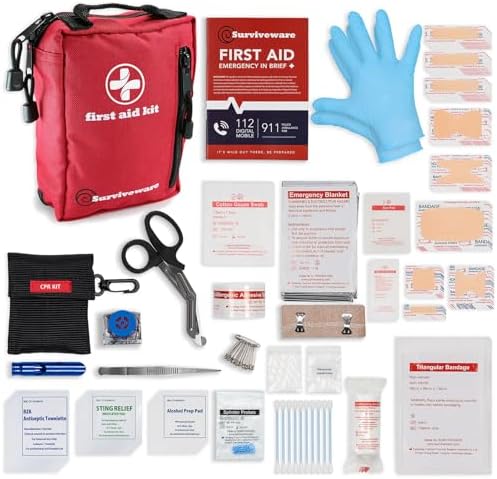
- 98 PIECE FIRST AID KIT: Includes 98 high-quality emergency essentials and first aid supplies to help care for minor woun…
- LABELLED FIRST AID KIT COMPARTMENTS: Labelled and organized inner compartments make it easy to find what you need in the…
- WATER RESISTANT AND RIP RESISTANT: Made from high-quality rip resistant 600D Polyester, this medical kit is water resist…
2. My Medic MyFAK Mini — Best Trauma Kit
Best for: families who drive remote routes and want serious trauma coverage.
The My Medic MyFAK Mini is a different kind of kit. Where the other kits in this guide are built for scrapes and small cuts, the MyFAK Mini is built for serious bleeding: it includes a tourniquet, QuikClot hemostatic gauze, and a chest seal, alongside 70 items of standard first aid supplies. It is the kit for a family that drives mountain roads, desert highways, or any route where an ambulance is an hour away and a bad cut could become a life-threatening bleed before help arrives.
At around $170–180, it is by far the most expensive kit in this guide, and it is overkill for a family that mostly drives near town. It also requires knowledge: a tourniquet and a chest seal are only useful if someone in the car knows how to use them, so pair this kit with a basic first aid course. If you do drive remote routes, it is the most important purchase in this guide — a tourniquet is the one item that can save a life, and no other kit here includes one.
- Pros: tourniquet, QuikClot, and chest seal for serious bleeding; 70 items in a compact pouch; built for remote driving.
- Cons: highest price in this guide; overkill for city driving; requires training to use the trauma items properly.

- COMPACT SURVIVAL KIT -This small first aid kit, equipped with over 45+ life-saving supplies, is a camping essential for …
- STANDARD KIT INCLUSIONS – Our first aid bag includes gloves, bandages, blister, mini burn aids, and hydration tools, and…
- RELIABLE FIRST AID – This camping medical kit is perfect for any camping, hiking, or backpacking adventure. Built in the…
3. Johnson & Johnson All-Purpose 140-Piece — Best Value Family Kit
Best for: budget buyers who want a complete basic kit for the whole family.
The Johnson & Johnson All-Purpose kit is the best value family kit in this guide: 140 pieces in a hard plastic case, for under $25. It covers the basics thoroughly — assorted bandages, gauze pads, adhesive tape, antiseptic wipes, burn cream, tweezers, and scissors — in a case that protects the contents from being crushed in the trunk. It is the kit to buy if you want a complete first aid kit for the price of a fast-food meal for the family.
The trade-off is depth. There is no trauma shears, no CPR mask, and no tourniquet, and the burn care is basic. For most family road trips, that is fine: the injuries you will actually treat are scrapes, small cuts, blisters, and minor burns, and this kit handles all of them. If you drive remote routes, add the Surviveware Small or the MyFAK Mini instead. For a family that mostly drives near towns and wants a solid kit for little money, this is the right buy.
- Pros: 140 pieces for under $25; hard plastic case protects contents; covers all the common family injuries; trusted brand.
- Cons: no trauma shears, CPR mask, or tourniquet; basic burn care only; the case is bulkier than a soft pouch.
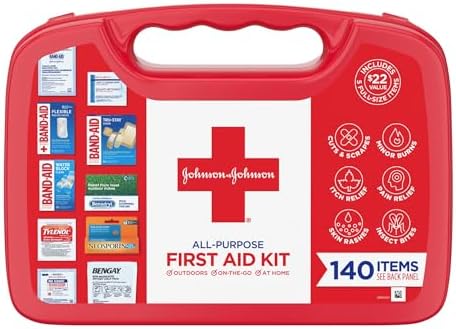
- 140-piece Johnson & Johnson All-Purpose Portable Emergency First Aid Kit is ideal for home, in cars, outdoors, dorm room…
- All-purpose, compact first aid kit includes essential first aid supplies like cleansing wipes, gauze pads, assorted band…
- Includes a variety of Band-Aid Brand Adhesive Bandages in assorted sizes for minor wound care, as well as Band-Aid Brand…
4. Johnson & Johnson First Aid to Go 12-Piece — Best Glove-Box Kit
Best for: the glove box, a purse, or a second car that needs a minimal kit.
The First Aid to Go kit is the smallest kit in this guide — 12 pieces in a pouch barely bigger than a phone — and it exists for one reason: to be there. It has a few bandages, antiseptic wipes, and a small gauze pad, which is enough for a scraped knuckle or a small cut, and it is small enough to live in the glove box permanently, where a larger kit would not fit. It is not a substitute for a real kit, but it is far better than nothing.
Buy one for each car and one for the diaper bag or purse. At this size and price, there is no excuse for a car without any first aid at all. Use it as a supplement to a full kit, not a replacement: the full kit stays in the trunk, and this one stays within arm’s reach of the driver’s seat.
- Pros: tiny enough for any glove box; very low price; covers the smallest injuries instantly; good as a supplement to a full kit.
- Cons: only 12 pieces; no burn care, no trauma supplies, no tools; not a substitute for a real kit.

- Emergency First Aid Essentials: Portable and compact First Aid Kit To Go by BAND-AID Brand delivers an assortment of 12 …
- Be Prepared While You Travel: Emergency kit contains two cleansing wipes, four gauze pads, and six assorted sizes bandag…
- Assorted Adhesive Bandages: First aid essentials featuring BAND-AID Brand Adhesive Bandages not made with natural latex …
5. Surviveware 184-Piece — Best Large Kit
Best for: large families and long trips where the kit may be used several times.
The Surviveware 184-piece kit is the larger sibling of the Small, with nearly double the supplies in an IPX7-rated case — which means it can survive being submerged in water, a useful feature if the kit lives in a trunk that leaks or a car that goes camping. It is a distinct listing from the Small, not just a bigger version of the same kit, with more bandages, more gauze, and more of everything a family uses repeatedly on a long trip.
For a family of four or five on a multi-day trip, the extra supplies matter: a kit that runs out of bandages on day two is a kit that has failed. The 184-piece kit is also the better choice if you want one kit that serves both the car and the campsite. It is larger and heavier than the Small, so it suits a trunk better than a glove box, and it costs more — but for a large family, the extra capacity is worth it.
- Pros: 184 pieces for a large family; IPX7 water-resistant case; more of every supply, so it lasts a long trip; same organized Surviveware layout.
- Cons: larger and heavier than the Small; higher price; overkill for a couple on a day trip.
How to Choose the Best Car First Aid Kits for Family Road Trips
Choosing among the best car first aid kits for family road trips starts with your family, not the box. A couple on a day trip needs far less than a family of five on a two-week drive, and a family with small children needs different supplies than a family of adults.
Contents: variety beats piece count
A kit that claims 200 pieces may contain 180 bandages and almost nothing else. What matters is variety: assorted bandage sizes including small ones for children, gauze pads, adhesive tape, antiseptic wipes, burn gel or burn dressings, tweezers, scissors, gloves, and a cold pack. The Surviveware Small earns its place in this guide because its 98 pieces are varied and include trauma tools; the Johnson & Johnson All-Purpose earns its place because its 140 pieces cover the common injuries thoroughly. When comparing the best car first aid kits for family road trips, read the contents list, not the headline number.
Hardcase vs soft pouch
A hardcase protects the contents from being crushed in a trunk full of luggage, and it keeps the kit organized. A soft pouch is lighter, fits in smaller spaces, and is easier to carry to a picnic table or a campsite. For a car that stays on the road, a hardcase is the better choice among the best car first aid kits for family road trips; for a car that also goes camping or hiking, a soft pouch is more practical. The Surviveware kits use water-resistant pouches; the Johnson & Johnson All-Purpose uses a hard plastic case. Either works — pick the one that fits where you will store it.
Children: small sizes and specific supplies
Children need small bandages, and they need them in a kit they can reach. A child’s scraped knee is the most common road-trip injury, and a kit with only adult-sized bandages will not cover it well. Add children’s pain reliever, children’s antihistamine, and any allergy medication your child needs — no pre-packed kit includes these, because they depend on the child. Keep the kit where an adult can reach it from the front seat, not buried under luggage in the trunk.
Medication: what no kit includes
No pre-packed kit in this guide includes medication, and that is by design — so even the best car first aid kits for family road trips need you to add pain relievers, antihistamines, and prescription drugs, which vary by family and have expiry dates. Add a small zip bag with your family’s usual medicines — pain reliever for adults and children, antihistamine, motion sickness tablets, and any prescription medication — and check the expiry dates twice a year. Keep the medication in the kit, not loose in the glove box, so it is findable in a hurry.
What Every Family First Aid Kit Should Contain
Use this checklist to audit any kit, including one you already own. If your kit is missing more than two items, add them before the next long drive.
- Assorted bandages — small, medium, and large, including children’s sizes.
- Gauze pads and adhesive tape — for larger cuts that a strip bandage cannot cover.
- Antiseptic wipes — to clean a wound before bandaging.
- Burn gel or burn dressings — for hot seatbelt buckles, coffee spills, and campfire burns.
- Tweezers and scissors — for splinters, ticks, and cutting tape and gauze.
- Gloves — to protect the person giving first aid.
- Cold pack — for bumps, sprains, and insect stings.
- Trauma supplies (optional, for remote routes) — a pressure bandage, and a tourniquet if someone in the car is trained to use one.
For the rest of what belongs in the car, see our guide to a car emergency kit with first aid, and for the full roadside picture, our guide to a roadside emergency kit for cars.
Common Mistakes to Avoid
- Buying by piece count alone. The most common mistake when shopping for the best car first aid kits for family road trips is choosing the kit with the biggest number on the box. A 200-piece kit of bandages is worse than a 98-piece kit with varied supplies and trauma tools.
- Never checking expiry dates. Bandages, antiseptic wipes, burn gel, and medication all expire. Check the kit twice a year and replace anything past its date.
- Storing the kit in the trunk. A kit buried under luggage is a kit you cannot reach when a child is bleeding. Keep the main kit in the trunk, but keep a small kit — like the Johnson & Johnson First Aid to Go — in the glove box within arm’s reach.
- Forgetting children’s medication. No pre-packed kit includes children’s pain reliever or antihistamine. Add a small bag of your family’s medicines and check the dates.
- Not knowing how to use it. A tourniquet you cannot use is dead weight. Take a basic first aid course — many are free or low-cost — and read the kit’s instructions before you need them.
Frequently Asked Questions
What are the best car first aid kits for family road trips?
For most families, the Surviveware Small 98-piece kit is the best all-round choice because of its varied supplies, trauma shears, CPR mask, and top rating in independent testing. The Johnson & Johnson All-Purpose 140-piece kit is the best budget option at under $25, and the My Medic MyFAK Mini is the best choice for remote routes where trauma coverage matters.
Which of the best car first aid kits for family road trips is best for small children?
The Surviveware Small is the best pick for families with small children, because its varied bandage sizes and organized compartments make it easy to find a small bandage quickly. Add children’s pain reliever, children’s antihistamine, and any allergy medication separately, since no pre-packed kit includes them.
Do I need a trauma kit, or is a basic first aid kit enough?
For most family road trips near towns, a basic kit is enough — the injuries you will treat are scrapes, small cuts, and minor burns. For remote routes where an ambulance is an hour away, a trauma kit like the My Medic MyFAK Mini, with its tourniquet and QuikClot, is worth the investment, provided someone in the car knows how to use it.
How often should I check my car first aid kit?
Twice a year is enough for the best car first aid kits for family road trips: once in spring and once before winter. Check the expiry dates on bandages, antiseptic wipes, burn gel, and medication, and restock anything you used. After any use — even a single bandage — replace what you took so the kit is complete for the next trip.
Where should I keep the first aid kit in the car?
Keep the main kit in the trunk, where it is protected and out of the way, and keep a small kit — like the Johnson & Johnson First Aid to Go — in the glove box within arm’s reach. A kit buried under luggage is a kit you cannot reach when a child is bleeding.
What medication should I add to a car first aid kit?
Add your family’s usual medicines: pain reliever for adults and children, antihistamine, motion sickness tablets, and any prescription medication. Keep them in a small zip bag inside the kit, and check the expiry dates twice a year. No pre-packed kit includes medication, because it varies by family.
Should I take a first aid course?
Yes, if you can. A basic first aid course — many are free or low-cost, and some are available online — teaches you how to use the kit properly, including the trauma items. A tourniquet you cannot use is dead weight, and a CPR mask you have never practiced with is hard to use under stress. For more on the full roadside picture, see our guide to an all-in-one car emergency kit.
Final Verdict
Our pick among the best car first aid kits for family road trips is the Surviveware Small 98-piece kit. Its varied supplies, trauma shears, CPR mask, and top rating in independent testing make it the most capable kit in this guide for the money, and its 16-ounce weight means it will actually stay in the car. If the budget is tight, the Johnson & Johnson All-Purpose 140-piece kit covers the common family injuries for under $25. If you drive remote routes, the My Medic MyFAK Mini is the most important upgrade you can make. Whichever you choose, the important part is the habit: check the kit twice a year, restock after every use, and keep a small kit in the glove box where you can reach it.
As an Amazon Associate, Car Accessories Reviews earns from qualifying purchases made through links on this page, at no extra cost to you. Prices change over time, so please check the current price on Amazon before buying.