Two phones, one cigarette lighter socket, and a drive longer than either battery. The driver needs navigation, the passenger needs music, and both phones are at 20%. A single-port charger forces a choice; a cheap dual charger splits the power so slowly that neither phone charges properly. The best dual USB car chargers with fast charging solve that: two ports, enough watts for both phones at full speed, and a design that fits the socket without blocking the gear shift.
This guide compares five dual-port chargers — from a $15.99 LISEN that charges two phones at 45W each, to a 130W UGREEN that can charge a laptop and a phone together — and explains the wattage numbers that actually matter, because the total on the box is not the number your phone will see.
Best Dual USB Car Chargers with Fast Charging at a Glance
| Charger | Total watts | Ports | Best for |
|---|---|---|---|
| Anker 323 | 52.5W | USB-C 30W + USB-A 22.5W | Most drivers |
| LISEN 90W | 90W | Dual USB-C 45W each | Best value |
| UGREEN 130W | 130W | USB-C 100W + 30W + USB-A 22.5W | Laptops |
| UGREEN 90W Retractable | 90W | Retractable USB-C 60W + ports | No cable clutter |
| Spigen ArcStation 47W | 47W | Lightning 27W + USB-C 20W | iPhone users |
Here are the best dual USB car chargers with fast charging we compared, with the strengths and limits of each spelled out so you can match the charger to your phones and your car.
1. Anker 323 52.5W — Best Overall
Best for: most drivers — the smallest, most reliable dual charger in this guide.
The Anker 323, model A2735, is the best all-round dual USB car charger here. It delivers 52.5 watts total — a 30-watt USB-C Power Delivery port and a 22.5-watt USB-A port — enough to fast-charge two phones at once. Anker states it charges an iPhone 14 Pro to 50% in 25 minutes, and it is listed at $19.99 with an 18-month warranty. It is tiny — 56 by 30 by 30 millimetres, 23.5 grams — so it sits almost flush in the socket and does not block the gear shift or the cup holder. Full specifications are on the Anker product page at anker.com.
The 30W USB-C port is the key number: enough for full-speed charging on any iPhone and most Android phones, while the 22.5W USB-A port covers a second phone or earbuds. The small size is the other advantage — a charger that sticks out gets knocked by knees and bags, and the Anker 323 barely protrudes. It is listed at $19.99 on Target.com and Anker’s own store, and on Amazon as model A2735 — check the listing to confirm the model number before you buy.
- Pros: 30W USB-C PD + 22.5W USB-A; charges an iPhone 14 Pro to 50% in 25 minutes; tiny at 56×30×30 mm and 23.5 g; listed at $19.99; 18-month warranty.
- Cons: 52.5W total is not enough for a laptop; no built-in cable.
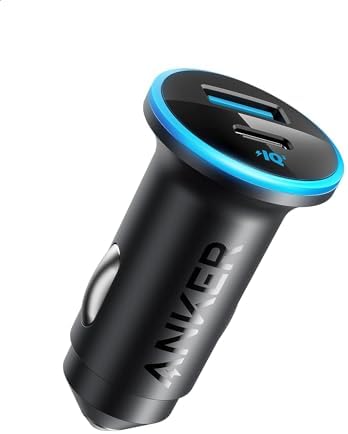
- High-Speed Charging: Connect to the USB-C port to charge an iPhone 14 Pro to 50% in just 25 minutes, or a Samsung S23 in…
- Charge 2 Devices at Once: The USB-C port offers 30W max charging while the USB-A port delivers up to 22.5W, so you can c…
- Wide Compatibility: From iPhone to Samsung to USB-C tablets and more, Anker's signature PowerIQ 3.0 technology provides …
2. LISEN 90W Dual USB-C — Best Value
Best for: drivers who want the most watts per dollar.
The LISEN 90W, model 2E790, is the best value dual USB car charger here. It has two USB-C ports, each delivering 45 watts, for 90 watts total — enough to fast-charge two phones at full speed, or a phone and a tablet, at once. It is made from zinc alloy, which feels more premium than plastic and dissipates heat better, and it is listed at $15.99 against a $23.99 list price, with a 4.6-star average from 2,294 ratings. LISEN states it charges a phone from 0 to 80% in 30 minutes.
The dual 45W ports set it apart: most dual chargers give you one fast port and one slow port, but the LISEN gives you two fast ports, so neither phone waits. The zinc alloy body stays cool under load and survives being knocked around. The trade-off is no USB-A port, so an older device that needs USB-A will need an adapter or a new cable. If both your devices use USB-C, this is the best charger for the money.
- Pros: dual 45W USB-C ports — both fast; 90W total; zinc alloy body; listed at $15.99; 4.6 stars from 2,294 ratings.
- Cons: no USB-A port for older devices; no built-in cable; 90W total is not enough for a laptop plus a phone at full speed.
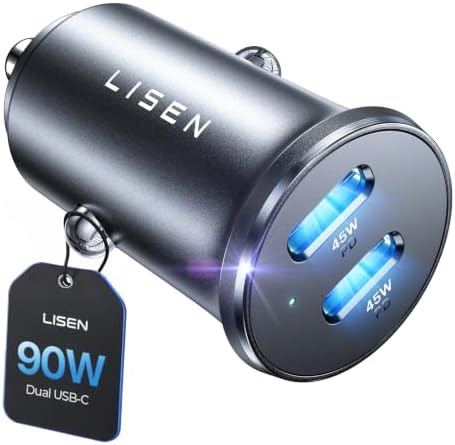
- THROW AWAY THE OLD A+C CAR CHARGER: What sets the LISEN usb c cigarette lighter adapter fast charger for iphone Duo & 18…
- DUAL USB C FOR VERSATILE CHARGING: The LISEN 90W cigarette lighter adapter usb c car charger for iPhone 18 Pro Max 12v l…
- PREMIUM METAL ALLOY SHELL: The LISEN 90W usb c car charger adapter for iPhone 18 Pro Max fast charging impresses right o…
3. UGREEN 130W — Best for Laptops
Best for: drivers who need to charge a laptop and a phone at the same time.
The UGREEN 130W, model CD293, is the most powerful charger here, and the only one that can charge a laptop. It has three ports: a 100-watt USB-C port, a 30-watt USB-C port, and a 22.5-watt USB-A port, for 130 watts total. The 100W port charges a MacBook or Windows laptop at full speed, the 30W port fast-charges a phone, and the USB-A port covers a third device. It supports PPS 45W for Samsung phones, weighs 1.4 ounces, and is listed at $29.99. The CD293 includes a 100W cable, though some variants do not — check the listing.
The 100W USB-C port is the reason to buy it: no other charger here can power a laptop, and a laptop dying on a road trip is a bigger problem than a phone dying. The trade-off is that the total is shared — if the laptop draws 100W, the phone ports have 30W left between them, still enough for a phone. If you do not need a laptop charger, the LISEN 90W is better value; if you do, the UGREEN 130W is the only charger here that can do it.
- Pros: 100W USB-C port charges a laptop; 130W total across three ports; PPS 45W for Samsung; 100W cable included on the CD293; listed at $29.99.
- Cons: total is shared — laptop at 100W leaves 30W for phones; larger than the Anker 323; check the listing for the included cable.

- 130W High-Power Output: Delivers blazing-fast charging with a total output of 130W, ensuring quick power delivery for yo…
- Superior Safety: UL tested and RoHS, CE & FCC certified, drive easy with protection from over-charge, over-current, over…
- Stylish & Practical: Advanced PC material with scratch-resistant body, your car phone charger will continue looking as g…
4. UGREEN 90W Retractable — Best Retractable
Best for: drivers who hate cable clutter and want a built-in charging cable.
The UGREEN 90W Retractable, model EC603, is the tidiest charger here. It has a retractable USB-C cable built in, rated at 60 watts, which pulls out when you need it and retracts when you do not — so no loose cable drapes across the dashboard or tangles in the gear shift. It delivers 90 watts total, is listed at $29.99, and is the charger to buy if cable clutter is your main frustration. For a deeper look, see our guide to a LISEN retractable car charger.
The retractable cable is the whole point, and it works well: it extends far enough to reach a phone in a mount, and retracts smoothly without snagging. The trade-off is that the built-in cable is USB-C only, so an iPhone with a Lightning port will need a separate cable or a different charger — the Spigen ArcStation below is the better pick for Lightning. If both your devices use USB-C and you hate clutter, this is the charger to buy.
- Pros: retractable 60W USB-C cable — no clutter; 90W total; listed at $29.99; clean dashboard.
- Cons: built-in cable is USB-C only — no Lightning; retractable mechanism adds a moving part that can wear; higher price than the LISEN 90W.

- Flexible Retractable Cable: UGREEN car charger features a retractable USB-C cable that extends up to 70cm. It automatica…
- 90W Fast Charging on 2 Ports: The total output power of both ports can reach 90W, and the retractable USB-C cable can re…
- Supports PD3.0/QC3.0: The built-in USB-C cable delivers an output power of up to 60W. Both the USB-C and USB-A ports sup…
5. Spigen ArcStation 47W — Best for iPhone
Best for: iPhone users who want a built-in Lightning cable.
The Spigen ArcStation, model PC2100, is the best charger here for iPhone users. It has a built-in MFi-certified Lightning cable delivering 27 watts — the fastest an iPhone can charge over Lightning — plus a 20-watt USB-C port for a second device, for 47 watts total. The MFi certification matters: Apple has certified the cable, so it will not trigger a “this accessory may not be supported” warning or damage the phone. The built-in cable means you never carry a Lightning cable in the car.
The trade-off is total power: 47 watts is less than the LISEN’s 90W or the UGREEN’s 130W, and the 20W USB-C port is slower than the 30W or 45W ports elsewhere. For an iPhone and a second device, that is enough — the iPhone charges at its maximum 27W, and the second device at 20W, full speed for most phones. If you have an iPhone and are tired of forgetting the cable, this is the charger to buy.
- Pros: built-in MFi Lightning cable at 27W — fastest for iPhone; 20W USB-C port for a second device; no cable to carry; Spigen build quality.
- Cons: 47W total is lower than the other chargers; 20W USB-C is slower than 30W or 45W ports; Lightning cable cannot be replaced if damaged.

- Total 47W Output: Each port supports 27W and 20W Max PD 3.0 Charging. 27W Output with Built-in lightning cable to charge…
How to Choose the Best Dual USB Car Chargers with Fast Charging
Choosing among the best dual USB car chargers with fast charging starts with per-port wattage, not the total on the box. A charger that claims 90 watts may give 45 watts to each port, or 60 to one and 30 to the other — and your phone only charges as fast as its port allows.
Total watts vs per-port watts
Total wattage is the maximum the charger can deliver across all ports at once; per-port wattage is what each device actually gets. An iPhone fast-charges at 20–30 watts over USB-C PD; a Samsung phone at 25–45 watts with PPS; a laptop needs 45–100 watts. The common mistake when shopping for the best dual USB car chargers with fast charging is buying by the total on the box: a 130W charger does not charge your phone at 130W — it charges at the speed of its port, which is 30W on the UGREEN 130W’s second port. Always check the per-port figures, not just the headline total.
USB-C vs USB-A
USB-C Power Delivery is the standard for fast charging in 2026: 30–100 watts, working with iPhones, Android phones, tablets, and laptops. USB-A with Quick Charge delivers up to 22.5 watts and works with older devices. A charger with both — like the Anker 323 or the UGREEN 130W — covers every device you own. A charger with USB-C only — like the LISEN 90W — is faster for modern phones but needs an adapter for an older USB-A device. If all your devices use USB-C, buy USB-C only; if you still have USB-A devices, buy a charger with both.
Built-in cable vs bring your own
A built-in cable — like the UGREEN Retractable’s USB-C cable or the Spigen’s Lightning cable — means you never forget it, and the dashboard stays tidy. A charger with no cable — like the Anker 323 or the LISEN 90W — means you bring your own, which is flexible but easier to forget. The rule is simple: if you always forget the cable, buy one with a cable built in; if you already have good cables, buy one without and save the money. For a wireless alternative, see our guides to a wireless car charger mount and a MagSafe car charger mount for iPhone.
Safety: fuses, heat, and cheap chargers
A car charger draws power from the cigarette lighter socket, protected by a fuse — usually 10 or 15 amps at 12 volts, or 120–180 watts. A 130W charger is within that limit, but a cheap charger with no over-current protection can blow the fuse or overheat. Buy from a known brand — Anker, UGREEN, LISEN, Spigen — with over-current, over-voltage, and over-temperature protection, and check that it does not get hot in use. A charger too hot to touch is one to replace. Never leave one plugged in with a damaged cable, and never use one that smells of burning plastic.
How to Use a Dual Car Charger Safely
Plug the charger into the cigarette lighter socket until it sits firmly — a loose charger loses contact over bumps and stops charging. Connect the phone with a good-quality cable: a cheap cable can limit charging speed even with a fast charger, because the cable itself has a wattage limit. If the phone is not fast-charging, check the cable first. Keep the charger in the socket when not in use — it draws almost no power idle — and remove it if you will not drive for weeks, because even a small idle draw can drain an old battery.
If the car has a built-in USB port, it is usually a slow 5-watt port meant for music, not charging — use the lighter charger instead. To charge without a cable, a wireless charging mount is the alternative: see our guide to a wireless car charger mount, or our guide to solar chargers for car for off-grid charging.
Common Mistakes to Avoid
- Buying by total watts alone. The most common mistake when shopping for the best dual USB car chargers with fast charging is choosing the biggest total on the box. Your phone charges at the speed of its port, not the total — check the per-port figures.
- Using a cheap cable. A fast charger with a slow cable is a slow charger. Use a cable rated for the wattage you need — 30W for a phone, 60W or 100W for a laptop — and replace frayed or damaged cables.
- Ignoring the car’s fuse. A 130W charger is within most cars’ 10–15 amp fuse limit, but one that draws more than the fuse allows will blow it. Check your car’s fuse rating before buying a high-wattage charger.
- Buying a no-name charger. A cheap no-name charger may lack over-current and over-temperature protection, which can damage a phone or blow a fuse. Buy from a known brand — Anker, UGREEN, LISEN, Spigen — and check for safety certifications.
- Leaving it plugged in for weeks. A charger left in a car that is not driven for weeks can drain an old battery. Remove it if you will not drive for a long time.
Frequently Asked Questions
What are the best dual USB car chargers with fast charging?
For most drivers, the Anker 323 is the best all-round choice, with a 30W USB-C PD port, 22.5W USB-A port, tiny size, and $19.99 price. The LISEN 90W is the best value with dual 45W USB-C ports, and the UGREEN 130W is best for a laptop.
Which of the best dual USB car chargers with fast charging is best for iPhone?
The Spigen ArcStation 47W is the best pick for iPhone users: its built-in MFi Lightning cable delivers 27 watts — the fastest an iPhone can charge over Lightning — and its 20W USB-C port covers a second device. The Anker 323 is the best alternative, with a 30W USB-C PD port that fast-charges an iPhone with a USB-C to Lightning cable.
How fast is fast charging in a car?
An iPhone fast-charges at 20–30 watts over USB-C PD, taking it from 0 to 50% in about 25–30 minutes. A Samsung phone fast-charges at 25–45 watts with PPS. A laptop needs 45–100 watts. The charger, cable, and phone must all support the same fast-charging standard — if any one is slow, the whole chain is slow.
Will a car charger drain the car battery?
Not while driving — the alternator recharges the battery faster than the charger can drain it. When the car is off, a charger left plugged in draws a tiny idle current, negligible over days but enough to drain an old battery over weeks. Remove the charger if you will not drive for a long time.
Can I charge two phones at full speed at the same time?
Yes, if the charger has enough watts per port. The LISEN 90W gives 45W to each USB-C port, so two phones charge at full speed. The Anker 323 gives 30W to USB-C and 22.5W to USB-A, full speed for most phones. A cheap dual charger that splits 10W between two ports charges both slowly — check the per-port figures before buying.
Is a retractable car charger better than a regular one?
It is better if cable clutter bothers you, because the cable retracts into the charger when not in use. It is worse if you need a Lightning cable, because most retractable chargers have a USB-C cable built in. The UGREEN 90W Retractable is the best retractable charger here; the Spigen ArcStation is the better pick for iPhone users who want a built-in Lightning cable.
Is it safe to leave a car charger plugged in?
Yes, if it is a quality charger from a known brand with over-current, over-voltage, and over-temperature protection. A charger that gets hot, smells of burning, or has a damaged cable should be replaced immediately. Never use a no-name charger with no safety certifications — it can damage your phone or blow the car’s fuse. For a wireless alternative, see our guide to a wireless Bluetooth speaker for car.
Final Verdict
Our pick among the best dual USB car chargers with fast charging is the Anker 323. Its 30W USB-C PD port, 22.5W USB-A port, tiny 56×30×30 mm size, and $19.99 price make it the most practical dual charger here. If you want the best value, the LISEN 90W gives dual 45W USB-C ports for $15.99. If you need to charge a laptop, the UGREEN 130W is the only charger here that can do it. Whichever you choose, check the per-port wattage, use a good cable, and buy from a known brand.
As an Amazon Associate, Car Accessories Reviews earns from qualifying purchases made through links on this page, at no extra cost to you. Prices change over time, so please check the current price on Amazon before buying.