The best compact jump starters for small cars are small enough to live in a glovebox and strong enough to start a dead battery on a cold morning. Small cars usually have 4-cylinder engines, sometimes a small 6-cylinder, and those engines need far less starting power than a truck or a diesel. That means you do not need a heavy workshop jump box. A compact lithium pack with 500 to 1500 peak amps, spark-proof clamps, and a USB port for your phone is the right tool for the job.
Why the best compact jump starters for small cars matter
Small cars are easy to underestimate. Their engines are smaller, so they need less cranking power, but their batteries are smaller too, and a small battery goes flat faster when the lights are left on or the car sits unused for a week. Cold weather makes it worse: a battery loses a large share of its cranking power as the temperature drops, which is why so many dead batteries show up on the first cold morning of winter.
How we chose these jump starters
We judged each model on five points that matter for a small car. Peak amps came first, but as a range, not a race: 500 to 1500 peak amps covers most 4-cylinder and small 6-cylinder gas engines, and more than that adds weight without helping a small car. Size and weight came second, because a pack that does not fit the glovebox will be left at home. Safety protections came third, followed by the power-bank function and the light, which decide whether the pack earns its space when the battery is fine.
- Peak amps: 500 to 1500A is the right range for small-car gas engines.
- Size and weight: glovebox-friendly, ideally under 2.5 pounds.
- Safety: spark-proof clamps and reverse-polarity protection as standard.
- Power bank: USB charging for a phone in an emergency.
- Light: a built-in LED torch with several modes for night use.
We also kept the scope tight. This guide is for small cars only. Drivers of large SUVs, trucks, or diesel engines need a bigger pack, and our guide to the best car jump starter for diesel trucks covers that job separately. If you are not sure about your engine size, check the owner manual or the badge on the back of the car before you buy.
Best compact jump starters for small cars at a glance
The table below gives a quick view of all five picks. The reviews that follow explain who each one suits best and where each one falls short, so read the full review before you buy.
| Product | Best for | Key feature | Check price |
|---|---|---|---|
| NOCO Boost Plus GB40 | Best overall | 1000A, up to 6.0L gas, UltraSafe clamps | Amazon |
| NOCO Boost GB20 | Smallest NOCO pick | 500A, up to 4.0L gas, lightest pack | Amazon |
| AstroAI S8 | Best budget compact | 1500A, up to 6.0L gas, under 1 lb | Amazon |
| GOOLOO GP2000 | Best power reserve | 2000A, up to 8.0L gas, USB quick charge | Amazon |
| HULKMAN Alpha85S | Best for cold weather | 2000A, preheat tech for very cold starts | Amazon |
1. NOCO Boost Plus GB40 — Best Overall
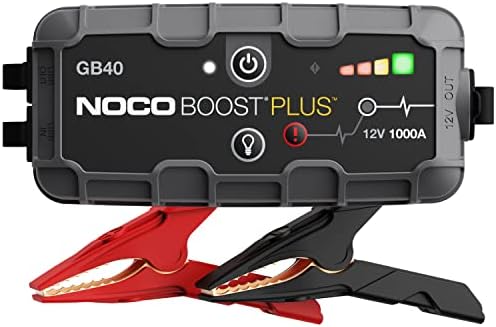
The NOCO Boost Plus GB40 is the best overall compact jump starter for a small car, and it is the most recommended pack in this category for good reason. It delivers 1000 peak amps, which NOCO rates for gas engines up to 6.0 litres and diesel engines up to 3.0 litres, and it weighs about 2.5 pounds. That covers every normal small car with room to spare, without the bulk of a larger pack.
The UltraSafe design is what sets it apart. The clamps are spark-proof and protect against reverse polarity, so the pack simply will not let you make the most dangerous mistake. It also works as a power bank with a USB port, and it has a built-in 100-lumen LED torch with seven modes, including an SOS strobe. The pack is compact enough for a glovebox and rugged enough to live in a trunk. That safety-first design is why it tops lists of the best compact jump starters for small cars.
- Pros: 1000A covers gas engines up to 6.0L with room to spare.
- Pros: Spark-proof, reverse-polarity UltraSafe clamps for safe use.
- Pros: Power bank and 100-lumen LED torch with seven modes.
- Cons: Not enough for large diesel trucks or repeated workshop use.
- Cons: Smaller capacity than bigger NOCO models.
- START DEAD BATTERIES — Instantly start dead batteries with 1000 amps of peak lithium power. Up to 20 starts per charge o…
- ULTRASAFE TECHNOLOGY — Engineered with patented spark-proof and reverse polarity protection for foolproof connections to…
- PORTABLE POWER BANK — Integrated power bank delivers emergency power to smartphones, tablets, and more. Recharges in 3 h…
2. NOCO Boost GB20 — Smallest NOCO Pick
The NOCO Boost GB20 is the smallest pack in the NOCO Boost range, and it is the right choice for the smallest cars. It delivers 500 peak amps, which NOCO rates for gas engines up to 4.0 litres, and it is lighter and more compact than the GB40. For a 4-cylinder city car, a hatchback, or a small sedan, 500 amps is enough, and the smaller size means it fits in the glovebox without a fight.
It shares the same UltraSafe approach as its bigger brother: spark-proof clamps, reverse-polarity protection, and a mistake-proof design. It also works as a USB power bank and includes an LED torch, so it earns its space even when the battery is healthy. The one-year limited warranty and the long history of the GB20 give it a reliability record that newer budget brands cannot match.
- Pros: Smallest and lightest NOCO pack, ideal for glovebox storage.
- Pros: 500A is enough for gas engines up to 4.0L.
- Pros: Same UltraSafe spark-proof design as the GB40.
- Cons: Less headroom on very cold mornings or with an old battery.
- Cons: Not suitable for engines above 4.0 litres.

- START DEAD BATTERIES — Instantly start dead batteries with 500 amps of peak lithium power. Up to 20 starts per charge on…
- ULTRASAFE TECHNOLOGY — Engineered with patented spark-proof and reverse polarity protection for foolproof connections to…
- PORTABLE POWER BANK — Integrated power bank delivers emergency power to smartphones, tablets, and more. Recharges in 3 h…
3. AstroAI S8 — Best Budget Compact
The AstroAI S8 is the budget pick that still delivers serious power for a small car. It is listed with 1500 peak amps, rated for gas engines up to 6.0 litres and diesel engines up to 3.0 litres, and it weighs about 0.95 pounds, which makes it the lightest pack in this guide. For a driver who wants the most power per pound at the lowest price, the S8 is hard to beat.
In use, the S8 follows the same pattern as the other packs: connect the clamps, start the car, and disconnect. It includes a USB power bank function and a three-mode LED light, and the compact size means it fits in a glovebox, a door pocket, or a small emergency bag. The 1500A rating gives it more headroom than the GB20 on a cold morning, which is useful if your battery is ageing.
- Pros: 1500A peak power at a budget price.
- Pros: Very light at about 0.95 pounds; fits anywhere.
- Pros: USB power bank and three-mode LED light included.
- Cons: Shorter brand history than NOCO.
- Cons: Check the listed engine range carefully against your car.

- FIRST TRY, EVERY TIME – The Astroai S8 car battery jump starter packs a 45C high-rate battery and 1500A peak — starts 6L…
- EMERGENCY POWER YOU CAN COUNT ON – The S8 car booster jumper starter will nail it every time, even on dead batteries. Au…
- EASY, PLUG AND PLAY – No complex setup. Connect clamps, press the button, and start your car in seconds – even in critic…
4. GOOLOO GP2000 — Best Power Reserve
The GOOLOO GP2000 is the pick for drivers who want the largest margin of safety in a small package. It delivers 2000 peak amps, rated for gas engines up to 8.0 litres and diesel engines up to 6.0 litres, and it includes USB quick charge and a Type-C port. That is more power than any small car needs, which is exactly the point: the extra headroom covers cold mornings, older batteries, and the occasional help for a neighbour’s larger car.
The GP2000 is still compact enough for a trunk or a large glovebox, and the USB quick charge means it can top up a phone quickly while you wait for help. The clamps include the usual safety protections against sparks and reversed connections, and the pack is designed for 12V vehicles including cars, motorcycles, and SUVs. For a driver who wants one pack that can handle almost any petrol car, the GP2000 is the most versatile choice here.
- Pros: 2000A peak power covers gas engines up to 8.0L.
- Pros: USB quick charge and Type-C port for fast phone charging.
- Pros: Enough headroom for cold mornings and older batteries.
- Cons: More power and weight than a small car needs.
- Cons: Larger than the glovebox-size picks in this guide.
5. HULKMAN Alpha85S — Best for Cold Weather
The HULKMAN Alpha85S is the cold-weather pick in this guide. It delivers 2000 peak amps, rated for gas engines up to 8.5 litres and diesel engines up to 6.0 litres, and it includes a preheat feature designed to help the pack work in very cold conditions, down to minus 40 degrees Fahrenheit. For a driver in a cold climate, that feature is worth more than any other specification on this page.
The Alpha85S is still compact at about 1.3 pounds for the main unit, and it includes a protective carry case, a USB power bank function, and an LED torch. The 2000A rating gives it the same headroom as the GOOLOO, so it can start a small car easily and help with larger vehicles too. The case keeps the clamps and cables organised, which matters when you are working in gloves in the cold.
- Pros: 2000A with preheat tech for starts in very cold weather.
- Pros: Light main unit with a protective carry case included.
- Pros: Power bank and LED torch for night emergencies.
- Cons: More pack than a small car in a warm climate needs.
- Cons: Higher price than the budget compact picks.

- Start Your Car: Deliver up to 2000 Amps peak amps to start vehicles with up to 8.5L Gas/6.0L Diesel engines. Up to jump-…
- ONE & ONLY Pre-Heat Tech in the world: The low temperature in winter is no longer a flat battery nightmare. Our preheati…
- [Come with Alpha Bag] All-round and durable protection: Made of top quality EVA material. This premium leather is select…
Buying guide: choosing the best compact jump starters for small cars
Start with your engine size, not with the biggest number on the box. A 4-cylinder petrol engine usually needs 400 to 600 peak amps, and a small 6-cylinder needs 800 to 1200. A 1000A pack like the GB40 covers both with margin. Buying a 4000A pack for a city car adds weight, size, and cost without making the start any more reliable. The right pack is the smallest one that covers your engine with a little headroom.
How many peak amps does a small car need
In the best compact jump starters for small cars, 500A is usually enough for a 4-cylinder petrol engine in mild weather, and 1000A gives comfortable headroom for cold mornings. For a small 6-cylinder, aim for 1000A or more. Diesel engines need more power than petrol engines of the same size, so a small diesel calls for a bigger pack. If you are unsure, check the owner manual for the battery size, or ask a mechanic what your car needs. Our guide to how many volts a car battery has explains the 12V system these packs work with.
Battery capacity and keeping it charged
A lithium jump starter slowly loses charge in storage, and a flat pack cannot start a car. Most packs hold a useful charge for several months, but you should check the battery indicator every month and top it up when it drops. A good routine is to charge the pack on the first weekend of each month, the same day you check your tyre pressures. Store the pack in the car, not in a hot garage, and avoid leaving it fully flat for long periods. Our guide on how often to replace a car battery explains why batteries fail and how to spot the signs early.
How to jump-start a small car safely
A jump starter is safer than jump leads, because there is no second car and no risk of reversed leads from another driver, but the routine still deserves care. Work in a safe place, away from traffic, and never smoke or use a naked flame near a battery. If the battery is cracked, leaking, or smells strongly of rotten eggs, do not try to jump-start it; call for help instead.
- Switch off the car, remove the key, and make sure the jump starter is charged.
- Connect the red clamp to the positive (+) terminal of the dead battery.
- Connect the black clamp to the negative (-) terminal of the dead battery.
- Switch on the jump starter and check that the status light shows it is ready.
- Start the car. If it does not start within a few seconds, wait a minute and try again.
- Once the engine is running, switch off the jump starter and remove the black clamp first, then the red clamp.
- Drive the car for at least 20 minutes, or take it to a garage to test the battery.
If the car still will not start after two tries, the problem may not be the battery. It could be the starter motor, the alternator, or a wiring fault, and further attempts will only drain the pack. Our guide to the best battery brand for cars can help if the battery itself needs replacing, and our article on car battery replacement cost explains what a new battery should cost. Keep a car emergency kit with jumper cables as a backup for the day the pack is flat. At that point the best compact jump starters for small cars have done all they can.
Frequently asked questions
How many amps do I need to jump-start a small car?
Most small cars with a 4-cylinder petrol engine need 400 to 600 peak amps, and a small 6-cylinder needs 800 to 1200. A 1000A pack covers both with margin, and it is the safest single choice for most small cars. Diesel engines need more, and large SUVs and trucks need a bigger pack. Check your engine size in the owner manual before you buy.
Can a compact jump starter damage my car?
A modern lithium jump starter with spark-proof clamps and reverse-polarity protection is very unlikely to damage a car when used correctly. The risk comes from connecting the clamps to the wrong terminals, which a good pack will prevent, or from using a pack on a damaged or leaking battery. Follow the steps in this guide, and do not jump-start a battery that is cracked or leaking.
How long does a jump starter hold its charge?
Most lithium jump starters hold a useful charge for three to six months in storage, but the exact time depends on the model and the temperature. A hot trunk drains the battery faster. Check the indicator every month and top up the charge when it drops below half. A pack that has been left flat for a year may not recover fully.
Can I charge my phone with a jump starter?
Yes. All five packs in this guide work as a USB power bank, so you can charge a phone or a small device from them. That is useful in an emergency, when you need to call for help. Remember that charging a phone uses the same battery that starts the car, so charge the phone only after the car is running, or keep enough charge in reserve for a second start attempt.
What is the difference between a jump starter and a battery charger?
A jump starter delivers a short burst of high power to start the engine, while a battery charger slowly refills a flat battery over several hours from a wall outlet. A jump starter gets you moving in minutes; a charger is for a battery that needs a full recharge at home. If your battery goes flat often, a charger and a battery test are a better investment than a bigger jump starter.
Should I buy a jump starter with an air compressor built in?
A combined jump starter and inflator is convenient, but it is usually larger and heavier than a compact pack, and the compressor is often slower than a dedicated inflator. For a small car, a separate compact jump starter and a separate compact inflator usually fit better and work better. If you have very little storage space, a combined unit is a reasonable compromise.
What are the best compact jump starters for small cars in cold weather?
For cold weather, choose a pack with more headroom than your engine strictly needs, such as the HULKMAN Alpha85S with its preheat feature, or the GOOLOO GP2000 with 2000 peak amps. Cold reduces a battery’s cranking power, so the extra amps compensate for the loss. Keep the pack itself warm by storing it in the car rather than in an unheated garage, and check its charge before winter. Our guide to the best car battery for cold weather covers the battery side of the same problem.
Final verdict
The best compact jump starters for small cars are small, safe, and strong enough for a 4-cylinder engine with a little headroom. For most drivers, the NOCO Boost Plus GB40 is the best overall pick: 1000A, proven safety, and a size that fits the glovebox. The NOCO GB20 is the lightest choice for the smallest cars, the AstroAI S8 is the best budget pick, and the GOOLOO GP2000 and HULKMAN Alpha85S are the strongest options for cold weather or maximum reserve.
Whichever of the best compact jump starters for small cars you choose, the routine matters more than the brand. Charge it every month, store it in the car, and learn the connection steps before you need them. A jump starter you can use confidently in five minutes is worth far more than a bigger pack you have never practised with. Put it in the glovebox this weekend, and you will never have to wait for a stranger with jump leads again.
As an Amazon Associate, we earn from qualifying purchases made through links on this page, at no extra cost to you. Prices and availability can change, so please check the current price on Amazon before you buy.