The tire pressure warning light comes on, and suddenly a simple drive feels uncertain. Is the tire actually low, or is the sensor just reacting to a cold morning? The only way to know for sure is a gauge of your own, and the best tire pressure gauges for everyday drivers cost less than a tank of gas while removing the guesswork completely.
A good gauge does two things: it reads accurately, and it reads fast enough that checking all four tires takes about two minutes. That is the whole job. This guide compares five gauges that fit that job — four digital models from JACO and AstroAI, plus the range and accuracy details that actually matter — so you can pick one, keep it in the glove box, and stop trusting the battered gauge at the gas station air pump.
Best Tire Pressure Gauges for Everyday Drivers at a Glance
| Gauge | Type | Range | Best for |
|---|---|---|---|
| JACO ElitePro Digital 100 PSI | Digital | 0–100 PSI | Most cars and SUVs |
| JACO ElitePro Digital 200 PSI | Digital | 0–200 PSI | Trucks and high-pressure tires |
| JACO ElitePro-X Digital | Digital | Check listing | Newer JACO pick |
| JACO Elite Digital 100 PSI | Digital | 0–100 PSI | Simple, no-fuss checks |
| AstroAI Digital 150 PSI | Digital | 0–150 PSI | Budget buyers |
Here are the best tire pressure gauges for everyday drivers we compared, with the strengths and limits of each one spelled out so you can match the gauge to your car, not to a marketing claim.
1. JACO ElitePro Digital 100 PSI — Best Overall
Best for: most cars, crossovers, and SUVs, and drivers who want one accurate gauge for years.
The JACO ElitePro Digital 100 PSI is the gauge most everyday drivers should start with. It is rated to the ANSI 2A accuracy standard, which means accuracy within ±0.5% of full scale, and it resolves to 0.1 PSI, so the difference between 31.8 and 32.0 PSI is visible on the display instead of hidden behind a needle. The range covers 0–100 PSI, which is far more than any passenger-car tire needs, and the backlit display makes a pre-dawn check readable without a flashlight.
The details are what make it a glove-box keeper. The brass chuck seals firmly on the valve stem, the air bleed valve lets you release a little pressure without pulling the gauge off and re-seating it, and the display holds the reading for a few seconds after you remove it, so you are not trying to read the screen while it is still pressed to the tire. At around $29.90, with a 4.7-star average across more than 7,100 ratings on its Amazon listing, it is the most proven gauge in this guide. It runs on a standard replaceable battery, and the body is built to survive being knocked around in a door pocket.
- Pros: ANSI 2A accuracy (±0.5% of full scale); 0.1 PSI resolution; backlit display; air bleed valve; holds the reading after removal.
- Cons: costs more than a basic pencil gauge; needs a battery eventually; 100 PSI range is overkill for small cars, though harmless.
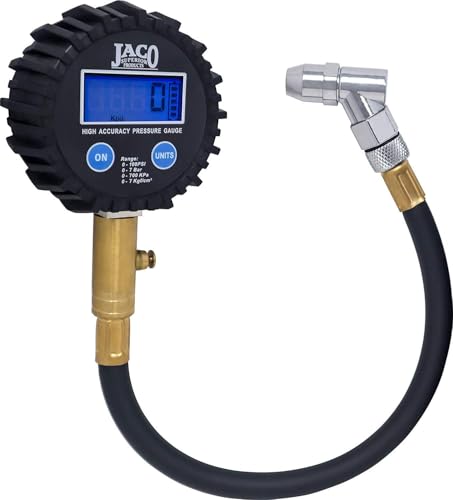
- PRO ACCURACY – mechanic recommended, performance tested, & calibrated accurate to professional ANSI 2A standards – with …
- STRONG & RUGGED – feels solid in the hand & built to last from 100% solid brass & steel parts shielded by our shock-resi…
- ADVANCED ENGINEERING – all readings lock-on to the display until the "ON" button is pressed once to reset to zero. Featu…
2. JACO ElitePro Digital 200 PSI — Best for Trucks and High-Pressure Tires
Best for: pickup trucks, towing setups, and any tire that runs above 60 PSI.
The ElitePro 200 PSI is the same ElitePro formula with a wider measuring range. If your truck tires run at 65 or 80 PSI, a 100 PSI gauge is working near the top of its range, where a small error matters more; the 200 PSI version keeps the reading comfortably in the middle of the scale. It carries the same ANSI 2A accuracy rating and 0.1 PSI resolution as the 100 PSI model, the same backlit display, and the same air bleed valve for fine adjustments.
For a normal sedan or crossover, this gauge is unnecessary — the 100 PSI model is the better buy. For a half-ton pickup, a heavy-duty truck, a trailer, or a motorhome, the extra range is the point. The chuck and hose layout are identical to the 100 PSI version, so if you already like the ElitePro feel, there is nothing new to learn. One gauge can cover the family car and the truck if the truck is the vehicle that actually needs the range.
- Pros: 0–200 PSI range for trucks and trailers; same ANSI 2A accuracy and 0.1 PSI resolution; backlit display; air bleed valve.
- Cons: more range than a car needs; slightly less resolution value at low pressures; same battery requirement as any digital gauge.
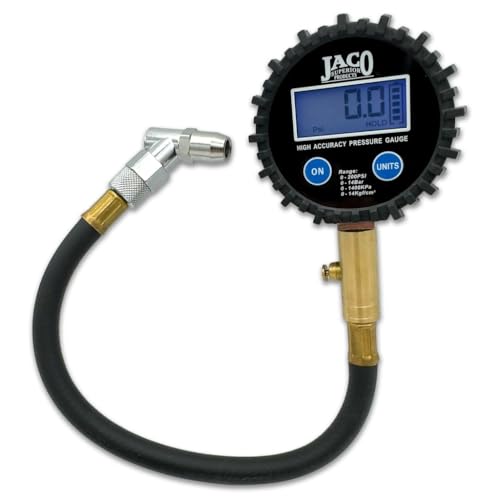
- PRO ACCURACY – mechanic recommended, performance tested, & calibrated accurate to professional ANSI 2A standards – with …
- STRONG & RUGGED – feels solid in the hand & built to last from 100% solid brass & steel parts shielded by our shock-resi…
- ADVANCED ENGINEERING – all readings lock-on to the display until the "ON" button is pressed once to reset to zero. Featu…
3. JACO ElitePro-X Digital — Best Newer JACO Pick
Best for: drivers who want the newest gauge in JACO’s ElitePro family.
The ElitePro-X is JACO’s newer digital gauge in the ElitePro line, and it is the one to check if you are buying in 2026 and want the latest revision rather than the long-running original. JACO positions it as the updated ElitePro, with the same focus on a clear digital readout and a solid chuck seal. Because listings for newer models can vary by seller and bundle, check the exact range, accuracy class, and included accessories on the Amazon listing before you buy, and match them against the 100 PSI ElitePro above.
What you are really choosing here is the newest hardware in a proven family. If the listing confirms the same ANSI 2A accuracy and a 0–100 PSI or wider range, it is a straightforward alternative to the original ElitePro — but if it costs notably more, the original gives you the same practical result for less.
- Pros: newest ElitePro revision; same trusted brand and family; digital readout with a solid chuck seal.
- Cons: specifications vary by listing, so verify range and accuracy before buying; may cost more than the original ElitePro with no practical gain.
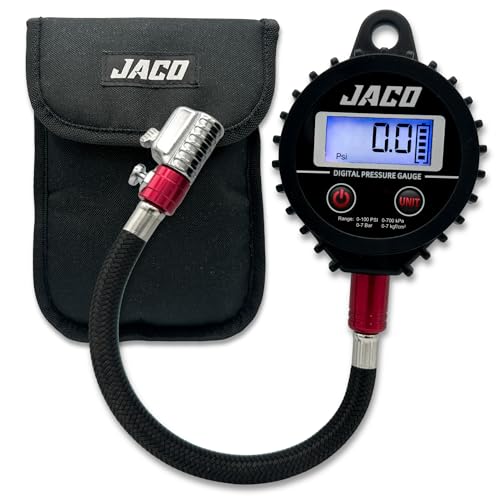
- HIGH ACCURACY – Performance-tested and calibrated to ±0.50% FS, delivering dependable readings in precise 0.10 PSI incre…
- LIGHTNING CHUCK – Patented push-to-lock nozzle instantly locks onto valve stems with a simple push—creating an airtight …
- QUICK-RELEASE – Instantly detach from the tire valve stem with absolutely zero air loss by pressing the quick-release bu…
4. JACO Elite Digital 100 PSI — Best Simple Digital Gauge
Best for: drivers who want a plain digital reading without extra features to learn.
The JACO Elite Digital 100 PSI is the simpler sibling in the JACO digital range: a 0–100 PSI digital gauge with a clear display and the same brass-chuck approach as the ElitePro models. It does the core job — press it on, read the number, done — without the ElitePro’s air bleed valve or hold-reading display. For a driver who checks pressure once a month and wants the number without squinting at a needle, that simplicity is a genuine advantage.
The trade-off is precision at the margins. The ElitePro’s 0.1 PSI resolution and ANSI 2A rating are the reason to spend more; the Elite Digital is for the driver who is happy with a whole-number reading and a lower price. It still beats any pencil gauge or gas-station gauge for repeatability, and it is small enough to live in the glove box permanently. If you run a single car and check pressure monthly, this is the least you should buy — and it is enough.
- Pros: simple one-button digital reading; 0–100 PSI covers every passenger car; compact and easy to store; lower price than the ElitePro.
- Cons: no air bleed valve for fine adjustments; no hold-reading display; less precise than the ANSI 2A ElitePro models.
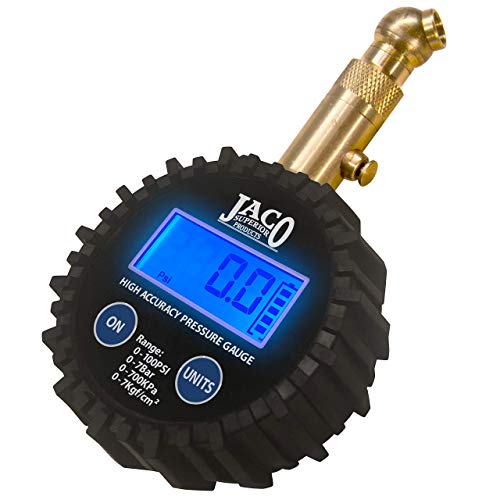
- SHOP-GRADE ACCURACY – mechanic recommended, performance tested, & certified accurate to professional ANSI 2A standards (…
- RUGGED & RELIABLE – feels sturdy in the hand & built from 100% solid brass shielded by our rugged shock-resistant protec…
- ADVANCED ENGINEERING – all readings lock-on to the display until the "ON" button is pressed to zero reading. Features bu…
5. AstroAI Digital 150 PSI — Best Budget Pick
Best for: budget buyers, second cars, and anyone who wants a spare gauge in the trunk.
The AstroAI Digital 150 PSI is the cheapest gauge in this guide, listed at around $7.49, and it is the best proof that a budget gauge can still be useful. It reads 0–150 PSI with a backlit display and an illuminated nozzle, so the valve is easy to find in the dark, and its stated accuracy is ±1 PSI — wider than the JACO ElitePro’s ±0.5% of full scale, but fine for catching a tire that is 5 or 10 PSI low, which is the problem that actually damages tires.
The honest limit is consistency. A budget digital gauge can drift a little over time, so treat its reading as a reliable warning rather than a laboratory measurement: if it says 28 PSI and the door sticker says 32, add air and re-check. For a second car, a teenager’s car, or a glove box backup, that is exactly the right job. If you want the most accurate reading in the guide, buy the JACO ElitePro instead; if you want a gauge in every car for the price of one ElitePro, buy two of these.
- Pros: very low price; backlit display with illuminated nozzle; 0–150 PSI range covers cars and light trucks; light and compact.
- Cons: ±1 PSI accuracy is wider than the ElitePro; budget build may drift over time; no air bleed valve.
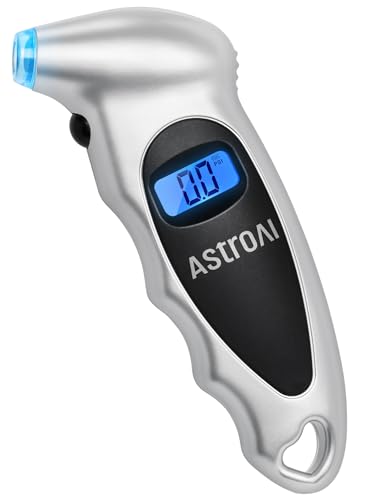
- Accurate, Dependable Readings: Factory‑calibrated to ±1 PSI, so you can confidently match your vehicle’s recommended PSI…
- Bright Backlit Display & Nozzle Light: The illuminated nozzle helps you find the valve stem in the dark, while the backl…
- 4 Measurement Units, One Button: Quickly switch among PSI, Bar, Kgf/cm², and KPA with a single press. No complex setting…
How to Choose the Best Tire Pressure Gauges for Everyday Drivers
Choosing among the best tire pressure gauges for everyday drivers comes down to four things: accuracy, range, the chuck, and the display. Get those right and the brand hardly matters; get them wrong and even an expensive gauge will annoy you every time you use it.
Accuracy: what the numbers actually mean
Accuracy is usually stated in one of two ways. ANSI 2A means the gauge is accurate within ±0.5% of its full scale — on a 100 PSI gauge, that is ±0.5 PSI at any reading, which is excellent for a 32 PSI tire. A gauge rated at ±1 PSI is accurate within 1 PSI of the true value, which is still good enough to catch an underinflated tire. What matters is not chasing the smallest number, but knowing that a gauge with no stated accuracy class at all is a gamble. If the listing does not state an accuracy figure, assume the worst and pick a different gauge.
Range: match it to your tires
Most passenger cars run at 30–36 PSI, so a 0–100 PSI gauge is ideal: your normal pressure sits in the lower third of the scale, where the gauge is most comfortable. A 0–150 PSI gauge is also fine for cars and adds headroom for light trucks. A 0–200 PSI gauge only makes sense for heavy-duty trucks, trailers, and motorhomes running 65–80 PSI. The common mistake when shopping for the best tire pressure gauges for everyday drivers is buying the biggest range on the shelf; a 200 PSI gauge on a 32 PSI tire is like weighing a letter on a bathroom scale.
Digital vs analog
Digital gauges are easier to read, especially at night, and they resolve to 0.1 PSI where an analog dial might hide a 2 PSI difference between markings. Analog dial gauges never need a battery and can be more rugged, but they are harder to read precisely and easier to damage if dropped. For everyday drivers, digital wins on readability; keep a pencil gauge as a backup if you like, but do not make it your only gauge.
Chuck, display, and hose
The chuck is the part that touches the valve, and a bad chuck leaks air while you measure, which makes every reading wrong. When you compare the best tire pressure gauges for everyday drivers, a brass chuck with a good seal is worth paying for. A backlit display matters more than it sounds, because pressure checks happen in dark garages and early mornings. A short hose helps on dual rear wheels and hard-to-reach valves, but for most cars a direct chuck is simpler and has fewer parts to fail. An air bleed valve is a small bonus that makes fine adjustments easy: press it briefly to release a little air instead of pulling the gauge off and starting over.
How to Check Tire Pressure the Right Way
Check pressure when the tires are cold — before driving, or after the car has sat for at least three hours. Driving even a mile warms the tires and raises the reading by a few PSI, which is why a hot check always looks fine even when the tire is actually low. Find the correct pressure on the sticker inside the driver’s door jamb, not on the tire sidewall: the sidewall number is the maximum the tire can hold, not the pressure your car needs.
Unscrew the valve cap, press the gauge chuck firmly onto the valve stem until the hissing stops, and read the number. If you hear air escaping around the chuck, re-seat it and try again. If the reading is low, add air in short bursts and re-check after each one; if it is high, use the bleed valve or press the valve core briefly with a small tool. Replace the valve cap when you are done, and check the spare too — a flat spare is only discovered when you already have a flat tire. A monthly check, plus a check before any long trip, is the routine that keeps tires wearing evenly and fuel economy where it should be.
That routine is also how you catch slow leaks early. If one tire keeps losing 3–4 PSI a month while the others hold steady, something is wrong — a nail, a bad valve stem, or a rim seal problem — and the gauge has just saved you a roadside tire change. For more on what a failing tire looks and feels like, read our guide to the signs of tire failure, and if you do find damage, our explainer on the types of tire repair will help you decide whether it can be fixed or needs replacing.
Common Mistakes to Avoid
- Trusting the gas-station gauge. Public air-pump gauges are dropped, rained on, and rarely calibrated. Use your own gauge to verify after filling.
- Checking hot tires. A hot tire reads 3–5 PSI higher than a cold one. Always check cold, or add 4 PSI to a hot reading as a rough correction and re-check cold later.
- Using the sidewall number. The sidewall shows the tire’s maximum pressure, not your car’s recommended pressure. The door-jamb sticker is the correct number.
- Forgetting the spare. Spares lose pressure over months of sitting. Check it twice a year so it is ready when you need it.
- Ignoring seasonal swings. Tire pressure drops about 1 PSI for every 10°F of temperature drop, which is why the warning light appears on the first cold morning of fall. See our note on tire pressure changes for the full picture.
Frequently Asked Questions
What are the best tire pressure gauges for everyday drivers?
For most drivers, the JACO ElitePro Digital 100 PSI is the best all-round choice because of its ANSI 2A accuracy, 0.1 PSI resolution, and backlit display. The AstroAI Digital 150 PSI is the best budget option, and the JACO ElitePro 200 PSI is the right pick if you drive a truck with high-pressure tires.
Which of the best tire pressure gauges for everyday drivers is most accurate?
The JACO ElitePro models are the most accurate gauges in this guide, rated to ANSI 2A, which means within ±0.5% of full scale, or about ±0.5 PSI on a 100 PSI gauge. The AstroAI 150 PSI is rated at ±1 PSI, which is still accurate enough for routine checks but less precise.
Are digital gauges better than analog gauges?
For most drivers, yes. Digital gauges are easier to read, especially in the dark, and they show 0.1 PSI increments that an analog dial hides. Analog gauges never need a battery and can be tougher, but they are harder to read precisely. A digital gauge with a backlit display is the best default choice.
What pressure range do I need?
For a car or crossover running 30–36 PSI, a 0–100 PSI gauge is ideal. A 0–150 PSI gauge also works and adds headroom for light trucks. Only buy a 0–200 PSI gauge if your tires actually run above 60 PSI, such as on a heavy-duty truck, trailer, or motorhome.
Can I rely on my car’s TPMS instead of a gauge?
No. A tire pressure monitoring system only warns you after pressure has already dropped by about 25%, and it does not tell you the exact number. A gauge tells you the precise pressure so you can top up before the warning appears. If you want to understand the system itself, read our guide to how a wireless tire pressure monitoring system works.
How often should I check tire pressure?
Once a month is the minimum, plus before any long road trip and whenever the temperature drops sharply. Tires naturally lose 1–2 PSI per month, and a cold snap can drop pressure by several PSI overnight. A monthly check takes two minutes and prevents uneven wear and wasted fuel.
Do tire pressure gauges need calibration?
Most consumer gauges cannot be calibrated at home. The practical approach is to compare your gauge against a known-good gauge once a year — at a tire shop, for example — and replace it if the readings disagree by more than 2 PSI. Budget gauges are more likely to drift, so check them more often.
Final Verdict
Our pick among the best tire pressure gauges for everyday drivers is the JACO ElitePro Digital 100 PSI. Its ANSI 2A accuracy, 0.1 PSI resolution, backlit display, and air bleed valve cover everything a daily driver needs, and its long track record makes it the safest buy in this guide. If you drive a truck or tow a trailer, step up to the ElitePro 200 PSI for the extra range. If the budget is tight, the AstroAI Digital 150 PSI does the essential job — catching a low tire before it becomes a problem — for a fraction of the price. Whichever you choose, the important part is the habit: check cold, check monthly, and keep the gauge where you can actually reach it.
As an Amazon Associate, Car Accessories Reviews earns from qualifying purchases made through links on this page, at no extra cost to you. Prices change over time, so please check the current price on Amazon before buying.